Showing posts with label Bar-tailed Godwit. Show all posts

Monday, December 12, 2011

Shorebird Count at Crab Creek

The other day I kayaked over to the Crab Creek roost with friends to do a count of the shorebirds. We counted almost 400 birds with the majority being Bar-tailed Godwits. The Godwits were lined up along the sandspit with most standing out in the water a little way. I was doing a second check on the bird count when I thought I saw something different. Finding one different bird among a couple of hundred others is not easy so I took lots of photos. There was definitely one bird that was smaller and moving differently from the Godwits but it was not until I got the photos home and had a good look that I could definitely ID it as a Sharp-tailed Sandpiper.
On the way back to the boat ramp I took a photo of the other kayakers with me. Sitting down so close to the water gives a different perspective to the everything else on the water.
For more bird photos visit the Bird Photography Weekly.

Sunday, April 17, 2011

Migrating Shorebirds

I went out to Inskip point the other morning. I thought that I was early enough to be the first out there but there was already a vehicle and boat trailer sitting out on the end of the point.
There were lots of birds out on the sand island and enough roosting on the point to make it interesting.
Most of the larger birds such as Bar-tailed Godwits and Eastern Curlews have left and the ones still here are possibly juveniles that will spend the winter here. I had seen very few Grey-tailed Tattlers (Tringa brevipes) when I was last out here a couple of weeks ago but now there were good numbers of them and most were in breeding plumage.
Although some were roosting by themselves at the edge of the water others were in among the Bar-tailed Godwits. This photo shows the considerable size difference between the two species.
This photo shows a Grey-tailed Tattler on the left, a Bar-tailed Godwit in behind and a Great Knot in the front. The Great Knot is in breeding plumage.
I saw a couple of Curlew Sandpipers also in breeding plumage in among the Bar-tailed Godwits. They are not easy to see when they walk in among the much larger birds.
For more bird photos visit the Bird Photography Weekly.
Monday, July 12, 2010

Shorebirds

Yesterday morning's sunrise was beautiful but the clouds that made it so beautiful also threatened more rain. There was an early shower of rain soon after I took this photo so my walk on the shoreline was delayed until the sky cleared a little more. I missed the high tide but also missed the early morning walkers and the shorebirds had a chance to settle down to the important business of feeding.
A pair of Pied Oystercatchers (Haematopus longirostris) can usually be found on a little rocky outcrop that becomes an island at high tide. When I went looking for them I found an Eastern Curlew (Numenius madagascariensis) and some Bar-tailed Godwits (Limosa lapponica) in the same place.The Eastern Curlew flew off quickly but the Pied Oystercatchers ignored me and I got close enough for good photos.A small group of Bar-tailed Godwits waded through the shallow water probing in the soft sand for food.I watched the clouds slowly getting darker and took off for home just before another shower of rain came through.
For more bird photos visit the Bird Photography Weekly.

Sunday, March 14, 2010

Bar-tailed Godwits - again!

At this time of year the Bar-tailed Godwits are changing color so quickly they are worth watching every day - and certainly worth a second post. I still haven't managed to see one with full breeding plumage up close enough to get a good photo. However, I have had a good chuckle at the way so many of them are waddling because of the extra weight they stack on right before migration. Then the other day while taking photos I got some with the birds in flight and realized that you can clearly see the fat bodies. The first photo shows their long beautiful wings. The next two photos are taken at an angle where the wings are hardly visible but the lovely plump bodies are easy to see. The birds need all this fat because they fly directly from here to the Yellow Sea area of China without a stop. The fat supplies the energy on this long flight.For more bird photos visit the Bird Photography Weekly.

Thursday, March 11, 2010

Norman Point

What a difference a few days makes. The first photo was taken on Sunday and the second photo on Wednesday - both looking east from Norman Point in Tin Can Bay.
This next photo was taken just an hour ago this morning. Five minutes after this the rain had set in again.
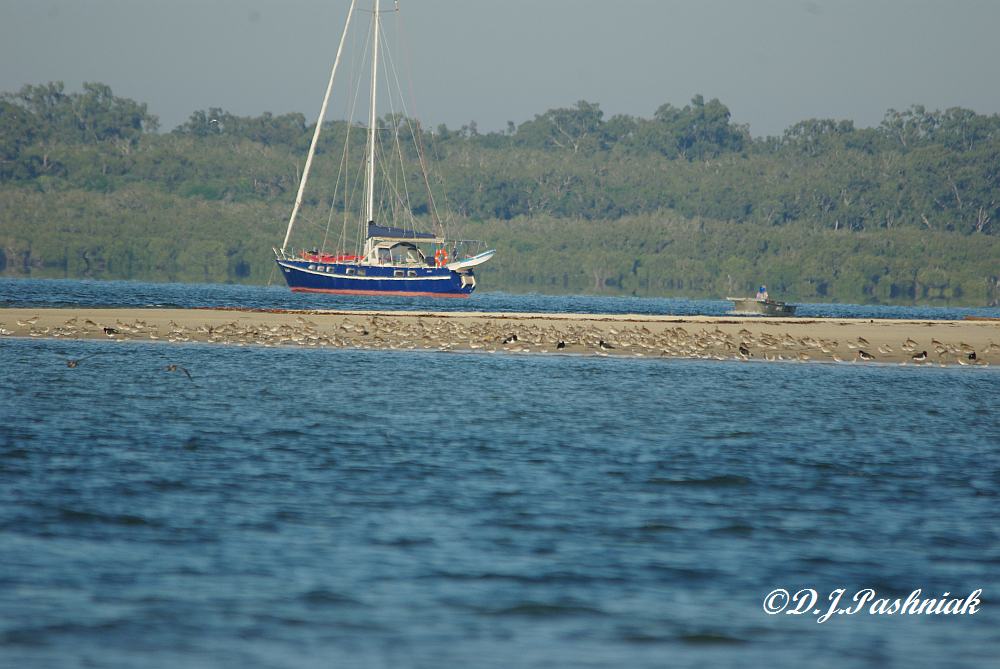
This photo zooms in on one of the boats out in the bay. My Dad loved all sailing boats. He had vivid memories of traveling on a sailing ship when he was a young boy.
There were numbers of Bar-tailed Godwits feeding out on the flats. All were at slightly different stages of moult into breeding plumage. All were feeding voraciously and hurrying from one suitable feeding spot to another.
This group of Godwits was in the curve of the bay just south from Norman Point this morning. It was raining and I was trying to keep the camera sheltered. Most of the Godwits were sleeping but even then one was still on the look-out for food.

Sunday, May 17, 2009

Mullens

What a beautiful day! The tide was covering the sand flats. There was no wind so the reflections were nearly perfect. Best of all I had the bay to myself! (Most of the photos in this post are landscapes and clicking on them to bring up the larger versions gives a better view of the area.)
Even though most of the shorebirds have migrated there were still a few around - both juveniles that will migrate next year and locals that stay here all year. Bar-tailed Godwits were standing in the shallow water and Red-capped Plovers and Red-necked Stint were busily hunting for food across the exposed sand. The birds were reflected in the sea and each little puddle.
A Little Egret hunted fish in the shallow water and then flew off when I got closer.
Pied Oystercatchers let me get quite close before they too flew off.
Nothing is perfect! The mosquitoes were terrible and I hadn't put on enough insect repellent to keep them away!


Thursday, March 26, 2009

Crab Creek

Yesterday was a great day - after nearly two months I got out in the kayak again. I paddled to the roost at South Crab Creek to see what shorebirds were still here. There was a little too much wind and the clouds came up and made everything quite dark before I left - but it was great to be out watching the birds like this again!
Numbers were well down from the huge numbers I had counted in December. This roost usually has hundreds of Bar-tailed Godwits but by now most of these have left on their northern migration. Some of the ones left are showing no signs of breeding plumage - these are possibly juveniles that will spend the winter here in the southern hemisphere. Others were nearly covered with the lovely brick-red breeding plumage on the front.
I decided to post this photo taken last season to show breeding color covering the male. The female on the left has not started changing plumage yet.
There were a surprising number of Whimbrels roosting in the mangrove trees lining the creek. I can't find records of these numbers this late in the season last year. It is almost impossible to see these birds at all until you are so close to them that some at least fly off. Whimbrels don't change color for their breeding plumage but do become darker and more heavily patterned.
There were small numbers of Grey-tailed Tattlers also roosting in mangrove trees. I noticed last year that these birds leave quite late in the season. Some were showing quite heavy breeding pattern on their fronts.
I also saw small numbers of Eastern Curlew, and Pacific Golden Plovers, and of course lots of Red-capped Plovers. These last are here all year round.

Sunday, October 19, 2008

Inskip Point

I had an interesting walk out at Inskip Point yesterday afternoon. The tide was higher than I had expected it to be so the only birds I saw were right up on the point where all the traffic goes. It always surprises me how many birds use the area despite the number of vehicles and people all around them.
The first waders I saw were Red-capped Plovers and Red-necked Stint busily hunting for food in an area of very soft sand. These are the Red-necked Stint.
There was one Eastern Curlew which definitely didn't want me to come any closer.
There was a juvenile Crested Tern that really didn't know what it should and should not be eating. This fish is poisonous and if it had managed to swallow it the result would be disastrous.
Then I spotted a single Whimbrel and tried to get closer to get a good photo but it was even more timid than the Eastern Curlew.
While I was slowly trying to get closer another bird flew in and landed close by. This was a juvenile Bar-tailed Godwit – the first I have seen this season. They leave the arctic some weeks after the adults have left. The plumage of the juveniles has quite a different pattern. They only keep this plumage for a few months after they reach here and then molt into the typical adult patterns. I will include a photo of an adult for comparison taken a few weeks ago.
The best sighting of the afternoon was when I was walking back to the car park along the bush track from the point. Unfortunately my attention was in the tree-tops where I could hear birds. I heard a rustle in the grass very close to my feet and was just in time to see Black-breasted Button-quail scurry into the longer grass. I was too slow getting the camera up to take any photos but it certainly made a nice end to the afternoon walk.