Showing posts with label Grey-tailed Tattler. Show all posts

Sunday, April 17, 2011

Migrating Shorebirds

I went out to Inskip point the other morning. I thought that I was early enough to be the first out there but there was already a vehicle and boat trailer sitting out on the end of the point.
There were lots of birds out on the sand island and enough roosting on the point to make it interesting.
Most of the larger birds such as Bar-tailed Godwits and Eastern Curlews have left and the ones still here are possibly juveniles that will spend the winter here. I had seen very few Grey-tailed Tattlers (Tringa brevipes) when I was last out here a couple of weeks ago but now there were good numbers of them and most were in breeding plumage.
Although some were roosting by themselves at the edge of the water others were in among the Bar-tailed Godwits. This photo shows the considerable size difference between the two species.
This photo shows a Grey-tailed Tattler on the left, a Bar-tailed Godwit in behind and a Great Knot in the front. The Great Knot is in breeding plumage.
I saw a couple of Curlew Sandpipers also in breeding plumage in among the Bar-tailed Godwits. They are not easy to see when they walk in among the much larger birds.
For more bird photos visit the Bird Photography Weekly.

Monday, January 31, 2011

Grey-tailed Tattlers

It's very frustrating when there are thousands of shorebirds around right now and the weather is too bad to go out and see them. We've had only intermittent rain recently but the winds have been extremely strong. My kayak is 4 meters long and it's not easy to get it onto the car roof racks when there is a strong wind.
This morning was still gray and overcast but it wasn't raining! The wind had dropped overnight and the tide was high very early. It was definitely worth a try for at least a close roost site.
I kayaked around to the roost we call the Airport Roost but the wind was picking up by the time I got there and this roost is very exposed. There were 3 Common Greenshanks which took off before I could get anywhere near and a couple of Pied Oystercatchers on the far end of the sand spit. There had recently been many more birds roosting there as I could see bird foot prints all over the sand.
I turned around and paddled up Mullens Creek to see if I could find any of the Grey-tailed Tattlers which sometimes roost in this area. I found a small group of 5 birds roosting in open Grey Mangrove trees.
By this time the wind was getting stronger and it was quite a hard paddle to get back to where I had left the car. Here's hoping for some fine and still weather - Soon!
For more bird photos visit the Bird Photography Weekly.

Sunday, November 14, 2010

Counting Shorebirds

All the shorebird roosts that we monitor and count present challenges but one of the most challenging is the one we call the Airport Roost. It is a sandbank with mangroves growing on both sides of it. I have kayaked in to the side closest to the land but I have never managed to get out there without disturbing some of the birds into flying off. On the other side you must sit in the kayak and count from there. You can come in close enough to see the birds fairly clearly.

However, Terek Sandpipers and Grey-tailed Tattlers use this roost. They roost on the sand, on exposed mangrove roots and in the open branches depending on the tide height. Terek Sandpipers and Grey-tailed Tattlers are easy to distinguish if they have their heads up - the Terek Sandpiper has a bill that turns up slightly and the Grey-tailed Tattler has a straight bill. There is a also a difference in the color around the eye. When they are roosting with their heads tucked under their wings it is much more difficult. The Terek Sandpiper has darker orange colored legs, but this is hard to see at a distance with only binoculars. In this photo two Grey-tailed Tattlers have their heads up. There is a Terek Sandpiper on the right of the photo - and the others I am not sure of!
Now, spot the different bird in this photo!
There is a Pacific Golden Plover on the left of the photo. This is the only time I have seen a Pacific Golden Plover roosting in a tree. There were other Pacific Golden Plovers there as well but they were all on the sand.
For more bird photos visit the Bird Photography Weekly.

Sunday, December 13, 2009

Searching for Shorebirds

There was an early high tide this morning and almost no wind - perfect conditions for a kayak. I decided to search for birds which have been flying off from a roost before I can either get a good view or count them.
First - because I am putting this post up on the Bird Photography Weekly Website I will post a photo of the only shorebird I got close to this morning - a Grey-tailed Tattler. Now for some details and scenic photos of my kayak trip.
I am first posting an image from Google Earth where I have marked the points where I kayaked. Google Earth makes this easy by allowing you to save the image you are viewing as a jpg image. All images can be clicked on and enlarged.
(1.) I set off from the Mullens Creek Picnic area and paddled out to the area we know as the "Airport Roost" (2.) However, before I even got that far a flock of Grey-tailed Tattlers had flown overhead and disappeared up into the Mullens Creek area. We haven't yet found out what is frightening off all the birds from this roost this year. The "Airport" roost only had a couple of Pied Oystercatchers left roosting on the sand so I set off for the other side of the bay.

(3.) It is quite a distance across here - I estimate about 1 1/2 Kms - but a pleasant paddle with calm conditions. From this point you can look further south to the Carland Creek area which is the most southerly portion of the Great Sandy Strait.
I have previously found birds roosting along the sand spit here but this morning there was nothing to be seen. I pulled the kayak up on the sand and walked behind the front line of mangroves and found a bigger area than I had expected. Most of it was very low lying and partly covered with the tide although there were several more sand spits intersecting the area. It was all more or less covered with different kinds of mangroves. I was wandering around and watching the Mangrove Honeyeaters which were flying around when I heard a soft call and recognized the call of Terek Sandpipers. These were the birds I had hoped to find. They were well hidden among the mangroves and I doubt that I would have seen them without first hearing them call. However, they obviously could see me and I had time to get one photo - good enough only for ID - before they flew off. I counted about 40-50 birds. This is the only part of the Southern Great Sandy Strait where I have seen these birds.
I paddled back across the bay and then up into Mullens Creek (4.) which is another area filled with mangroves.
Once again I heard birds before I saw them - this time Grey-tailed Tattlers. They were roosting in mangrove trees which had very open branches to give them a good view of whatever was around. I counted 30+birds. 70-80 total birds is not a huge number for this roost and not as many as we have counted on previous years. Now that I know for sure where the birds are flying off to I will need to repeat this same kayak trip in another few weeks.

Thursday, March 26, 2009

Crab Creek

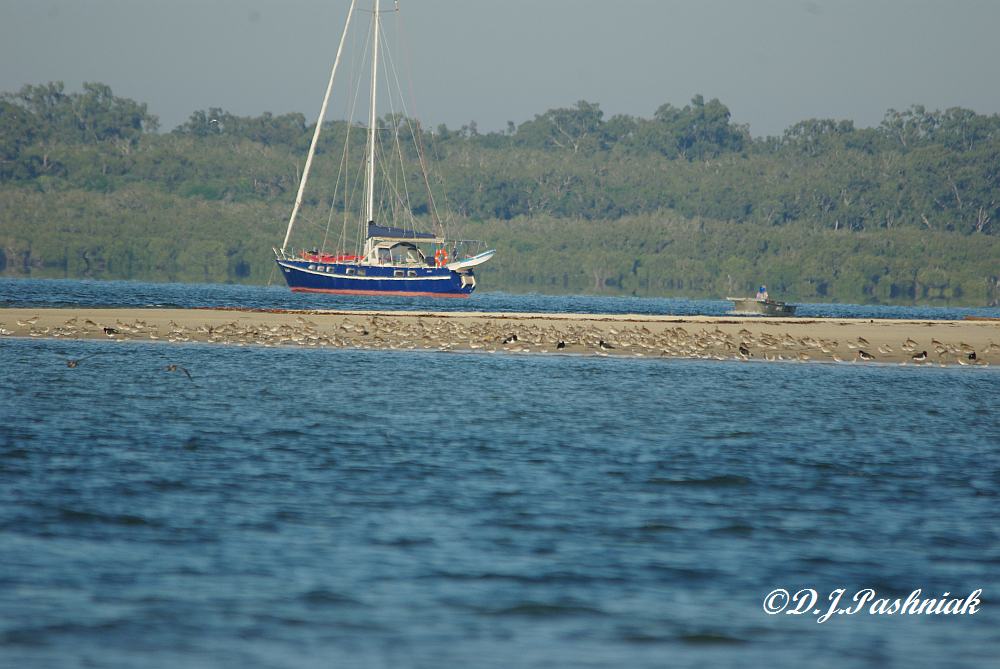
Yesterday was a great day - after nearly two months I got out in the kayak again. I paddled to the roost at South Crab Creek to see what shorebirds were still here. There was a little too much wind and the clouds came up and made everything quite dark before I left - but it was great to be out watching the birds like this again!
Numbers were well down from the huge numbers I had counted in December. This roost usually has hundreds of Bar-tailed Godwits but by now most of these have left on their northern migration. Some of the ones left are showing no signs of breeding plumage - these are possibly juveniles that will spend the winter here in the southern hemisphere. Others were nearly covered with the lovely brick-red breeding plumage on the front.
I decided to post this photo taken last season to show breeding color covering the male. The female on the left has not started changing plumage yet.
There were a surprising number of Whimbrels roosting in the mangrove trees lining the creek. I can't find records of these numbers this late in the season last year. It is almost impossible to see these birds at all until you are so close to them that some at least fly off. Whimbrels don't change color for their breeding plumage but do become darker and more heavily patterned.
There were small numbers of Grey-tailed Tattlers also roosting in mangrove trees. I noticed last year that these birds leave quite late in the season. Some were showing quite heavy breeding pattern on their fronts.
I also saw small numbers of Eastern Curlew, and Pacific Golden Plovers, and of course lots of Red-capped Plovers. These last are here all year round.