Showing posts with label Crested Terns. Show all posts

Sunday, October 30, 2011

Crested Terns

This post is for the Bird Photography Weekly.

Crested Terns are coming in to breeding plumage and getting ready to fly off to the off-shore islands where they will breed and raise their young. I watched these ones the other day - in full breeding plumage - strutting around among a flock of other terns. Their crests were raised as part of the display they were putting on.

Wednesday, June 22, 2011

Inskip Point

This post is for World Bird Wednesday.

It was a beautiful morning at Inskip Point yesterday - bright sunshine and enough wind to make the boats with sails move along quickly.
Because it is winter here now I don't expect to see many shorebirds and the only ones I saw yesterday were a small flock of Red-capped Plovers roosting in the tire tracks on the dry sand.
Crested Terns are here all year round and there were about 50 of them roosting together at the edge of the water. They were in all stages of moult and it was quite difficult to pick the adults from the juveniles.
While some were sitting and sleeping and others were preening their plumage there were a few that decided they needed a bath and were splashing around in the shallows. They really made the water fly - then when they were finished, with one quick shake of the wings, they flew off onto the sand again.
The surprise of the morning came as a I walked off the sand to the track through the bush. There were three Sacred Kingfishers on the sand. I have seen Kingfishers catch small crabs at other times so assume that's what these ones were doing - although they were just sitting still when I saw them.

Sunday, October 31, 2010

Fraser Island

The other day I had a trip over to Fraser Island. (For the benefit of overseas readers Fraser Island is the largest sand island in the world and is World Heritage listed.) I frequently go to Inskip Point and look across the channel at Fraser Island but had never been across there before.
A number of times while observing and photographing the shorebirds at Inskip I have seen flocks of birds, which have been disturbed by boats, or people, heading north-east across the channel to Fraser Island. I had been told that birds roosted at Hook Point and I wondered if this was where the shorebirds went when disturbed at Inskip Point.
I wouldn't have managed any part of this trip without the help and advice of DERM (Department of Environment and Resource Management) and QPWS (Queensland Parks and Wildlife Service) personnel. Moyra is involved in the management strategy for shorebirds in the Sandy Strait and she arranged for Ivan - who has an enormous amount of knowledge about the island and its wildlife - to meet us over there. Thanks to both!
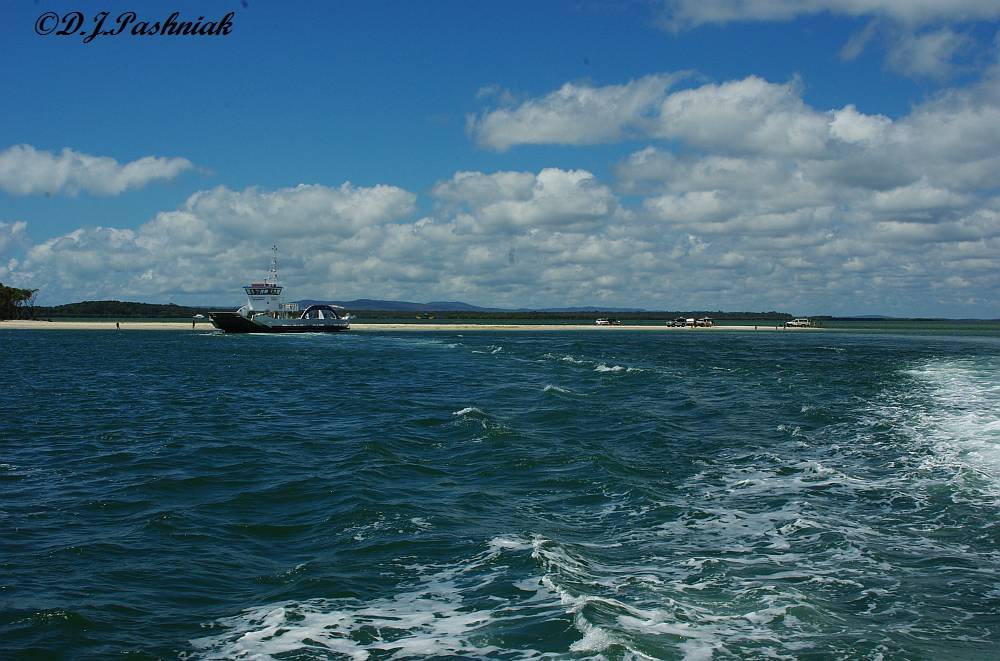
We took the barge from Inskip Point to the island. This photo looks back to Inskip Point where I usually stand and watch the barges!
Although we still had about 2 hours to go until high tide it was impossible to drive north on the beach. There just wasn't enough beach left out of the water! (btw I was very glad that I didn't have to do the driving as I have no experience with 4 wheel drives - and I am now not at all sure that I want it! Most of it was fun but some of it was a bit "dicey"! Moyra did a great job at all this!) The inland route is well graveled but extremely corrugated. These two photos were taken through the front window of the vehicle.
Ivan advised us how to access part of the beach north of Hook Point where there was a good wide stretch of beach well above the high tide mark for the day.
He also suggested that we drive north to where he had frequently seen birds roosting along the edge of the beach. The first birds that we came to were a small (100-200) flock of terns and a smaller flock of shorebirds. We parked well away so we didn't disturb them and then I went closer with binoculars and camera to get a better look. The shorebirds were Grey Plovers - just over 50 of them. I have never seen flocks of these birds on any roosts in the Strait. These ones were standing just out of reach of the breaking waves and just over a lip of sand which made them hard to see and photograph. Some of the birds still had dark patches of breeding plumage visible on their white fronts.
We drove north again but apart from flocks of thousands of terns we saw no more shorebirds. Then we headed south right down to Hook Point and again all we saw were terns - and one or two Whimbrels.
Part of a flock of terns- looking across the channel to the Inskip Point camp ground.
Looking south to the colored sand cliffs south of Rainbow Beach and Double Island Point in the distance.

So I am left with more questions than answers. Where do the shorebirds go when I have seen them flying off from Inskip Point? Do they only roost in the Hook Point area when there is absolutely nowhere else for them to go? It is very open and not the kind of place where shorebirds prefer to roost.
Of course Fraser Island is also known for being home to numbers of dingoes. I was so intent on looking for birds that I didn't even try to see a dingo. We had stopped both vehicles and were having a final consultation when a dingo walked out of the bush right beside us! Then it strolled across the road and sat down in the bush just across from us and watched us. Where's my camera? Grab it! Quick take a photo even though it's not the right lens. Do I have enough time to put the long lens on the camera again? The dingo stayed put and I got my photo!
For more bird photos visit the Bird Photography Weekly.

Wednesday, May 12, 2010

Crested Tern EXTRA

Crested Tern EXTRA
(This is so interesting that I couldn't resist using some color to make it eye-catching)
When I posted the photos of the Crested Terns earlier in the week I knew that the birds in breeding plumage at this time of the year did not fit the pattern of what I have seen until now. Crested Terns breed down here approx. Dec-Feb - so what were these two birds doing in breeding plumage at the 'wrong' time of the year? I contacted Jill Dening and asked for her opinion. She contacted others and received back information about a trip made out to the Swain Reefs (out from Mackay) by people from DERM during July 2009. They observed and photographed colonies of Crested Terns nesting and with young at this time. The birds that I observed in breeding plumage out at Inskip Point the other day possibly came from a northern population which breeds at the opposite time of the year from the ones we usually see here in southern Queensland.
Just another small piece of information to add to our current knowledge.

Sunday, May 9, 2010

Crested Terns

Out at Inskip Point today there was a group of Crested Terns (Sterna bergii) in all stages of plumage. There were plenty of juveniles in mottled plumage, scruffy looking adults part way through a moult and even a couple of adults in almost full breeding plumage.
Juvenile on the left, adult on the right and a couple of Silver Gulls in front.
Two adults in almost full breeding plumage in the front.
A juvenile in flight.
Rainbow Beach is south of Inskip Point and I decided to go up to the Sand Blow which is only a short distance from the town. There are tall sand cliffs between Rainbow Beach and Double Island Point. These cliffs are constantly eroding and at this point they have created a 'sand blow' from the sea side well over onto the land on the west. The sand is constantly moving and encroaching further west.
Looking across the sand blow. People walking across give an idea of the size of the sand.
Looking east towards Double Island Point.
Looking west - part of the town of Rainbow Beach is in the foreground, Carlo Creek with boats at anchor is on the right in the middle of the photo and boats at anchor near Tin Can Bay in the background.
For more bird photos visit the Bird Photography Weekly.

Friday, September 4, 2009

Crested Terns

There was quite a large flock of Crested Terns roosting out on a sandbank at Inskip the other day. Low tide was a bit after mid-day and these birds had apparently had time to go out to sea and fish then come in again for a bit of a rest before some more fishing later in the afternoon. (click to see a larger image showing the extent of the flock.)
Breeding season is around Christmas/New Year and so most of these birds were still looking a bit scruffy in only partial breeding plumage. This one, however, was one of a few in nearly complete breeding plumage.
I always think terns look best when they are in flight or when they have their wings raised and are about to fly off. It is also the easiest time to see how the wing moult is progressing. As far as I can see these have the final primary feather just growing back or else are just about to moult the last one. (This post is part of Bird Photography Weekly)

Sunday, April 26, 2009

Terns

Yesterday was a very low tide and I was able to walk a long way out on the sand banks to where a flock of terns was roosting. I scanned quickly through the flock to see what was there before I started taking photos. There were mainly Crested and Common Terns - and the Crested Terns were most obvious because of the constant noise the juveniles were making. It was only after I started taking photos that I realized that there was one White-winged Black Tern in almost full breeding plumage. These terns are never easy to get close to and its been a couple of seasons since I have seen any in breeding plumage. I didn't get close enough for really detailed photos but sufficient to show the spectacular plumage that these birds get when breeding.
First a photo which I have posted before to show non-breeding plumage.
The White-winged Black Tern is on the right and a Common Tern on the left.
Here the bird fluffed out its wing feathers
A blurry flight shot which nevertheless shows the wing colors.
A Crested Tern going into non-breeding plumage
Common Terns going into breeding plumage
A Caspian Tern

As I walked back I was just in time to see this parachute coming in with tandem jumpers. I don't know where they had come from as I only saw them just before they landed.

Sunday, October 19, 2008

Inskip Point

I had an interesting walk out at Inskip Point yesterday afternoon. The tide was higher than I had expected it to be so the only birds I saw were right up on the point where all the traffic goes. It always surprises me how many birds use the area despite the number of vehicles and people all around them.
The first waders I saw were Red-capped Plovers and Red-necked Stint busily hunting for food in an area of very soft sand. These are the Red-necked Stint.
There was one Eastern Curlew which definitely didn't want me to come any closer.
There was a juvenile Crested Tern that really didn't know what it should and should not be eating. This fish is poisonous and if it had managed to swallow it the result would be disastrous.
Then I spotted a single Whimbrel and tried to get closer to get a good photo but it was even more timid than the Eastern Curlew.
While I was slowly trying to get closer another bird flew in and landed close by. This was a juvenile Bar-tailed Godwit – the first I have seen this season. They leave the arctic some weeks after the adults have left. The plumage of the juveniles has quite a different pattern. They only keep this plumage for a few months after they reach here and then molt into the typical adult patterns. I will include a photo of an adult for comparison taken a few weeks ago.
The best sighting of the afternoon was when I was walking back to the car park along the bush track from the point. Unfortunately my attention was in the tree-tops where I could hear birds. I heard a rustle in the grass very close to my feet and was just in time to see Black-breasted Button-quail scurry into the longer grass. I was too slow getting the camera up to take any photos but it certainly made a nice end to the afternoon walk.

Thursday, September 11, 2008

Crested Terns

I found it a daunting experience when I was first confronted with a flock of several thousand terns. Nearly three years later and it is even more frustrating since I am now aware of how much I still don't know! I am learning! But I wish it could be faster!

I am greatly indebted to Jill Dening from the Sunshine Coast. First she let me join her group which was surveying all shorebirds and seabirds on the Noosa River sandbanks. Then she is a great teacher and extremely patient with questions which have to be asked and answered a number of times. The other members of the group, who are all more experienced than I am, have also been a great help.

This post is just about Crested Terns. It is an attempt to give some idea of the sequence of moult throughout the year. I will not include photos from every month but enough to show the changes in plumage throughout the year.

January: the first bird is in breeding plumage. The next is a juvenile which appears to have been born very late in the previous season.


February: An adult still in breeding plumage with a juvenile and next a juvenile and an adult going out of breeding plumage.
April: A juvenile begging for food from an adult. There are always a few juveniles that continue to beg from an adult (presumably a parent) long after they have come here from the islands where they are born. They are well able to look after themselves and Jill says that she has never seen one actually being fed.
June: First an adult well into non-breeding plumage and next two juveniles from the last breeding season.
August: An adult about to go into breeding plumage.
October: Adults in breeding plumage. The second photo shows the birds strutting around and displaying their plumage.
November: An adult on the left but not in breeding plumage and a juvenile from the previous season.