Showing posts with label Red-capped Plover. Show all posts

Wednesday, December 21, 2011

Small Shorebirds

This post is for World Bird Wednesday.

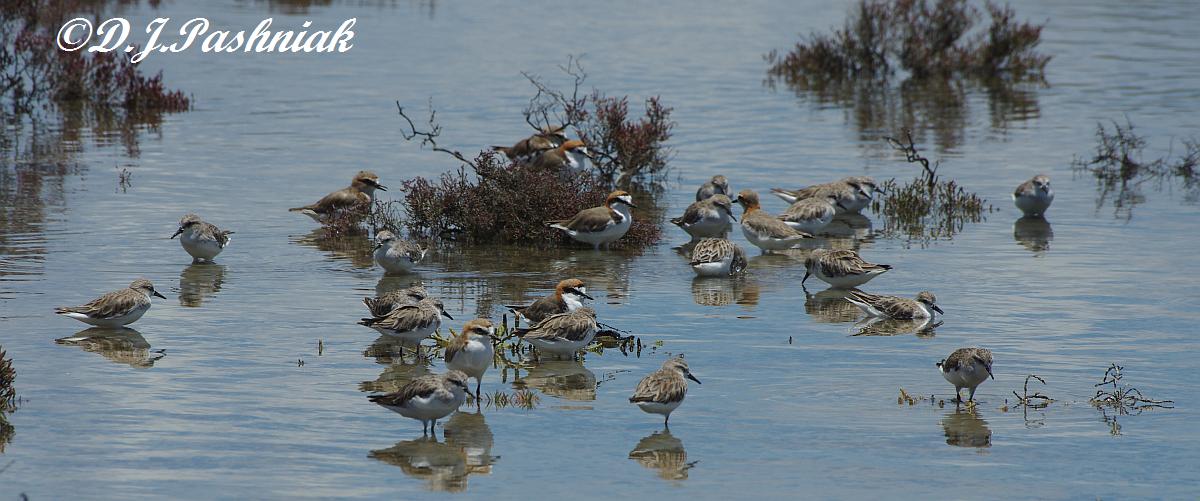
When I walked out to Mullens the other day the bigger shorebirds were all at the far side of the roost. Since I had walked out instead of kayaking there was no way I could get closer to them. However the smaller shorebirds were in their preferred roost site at the southern end of the roost and all I had to do was wade through some shallow water. They were standing in shallow water in among the saltmarsh plants. Red-capped Plovers and Red-necked Stints were roosting together. Both of these birds are only 15cm (6 inches) beak to tail. Red-capped Plovers are an Australian shorebird and stay here all year. Quite a few were showing their beautiful red caps. Red-necked Stints are the smallest of all the shorebirds that migrate from the arctic to spend the summer here. They only show their red necks just before they migrate north - that is in March and April.
Wednesday, September 21, 2011

Red-capped Plover

This Post is for World Bird Wednesday.

I walked across the salt marsh flats on Monday to see if there were any Godwits back yet but could not see any at all. However, while I was walking across the flats I heard a Red-capped Plover and then it flew quite closely past me. It then fluttered to the ground and did its best to convince me it was hurt in some way and I should go and investigate. It was the old 'broken wing' technique to lure me away from where it had either a nest or a young one hidden. When I was far enough away it stood up tall and flew off quite well. I just hope the nest is far enough above high tide to be safe - or that the young one is able to move away. The bird is a female and the typical red on the head is not as dark as the male has.

Sunday, May 8, 2011

Photographing at Inskip

When I go out to photograph the shorebirds I am usually less concerned with getting the perfect bird photo than with recording the numbers and species I see that morning. Some of my friends 'count' before all else and then keep meticulous lists. I get a better end result if I take lots of photos.
Photos of scenery or some thing that makes the day memorable are a good way for me to fix the rest of the details in memory. The other morning at Inskip Point as I looked north along the Strait between the mainland and Fraser Island there were a number of large vessels which I could not immediately identify. It appeared that they were anchored up that way and then after a while - when the tide came in a little more - they came south and appeared to be making for Tin Can Bay. I have seen similar vessels before - something to do with the army (which has a base close to the southern end of the Bay) I think.
There was a huge difference in the numbers of birds at Inskip from the last time I was out there. I saw no large waders at all. This might have been because the tide was not very high and they could have still been feeding on some of the exposed sand banks. There were approximately 150 small waders - very different from the large numbers I saw last time. (I will record this number and attach it to the photos for the morning.) They were making use of the dry sand and wheel tracks of all the vehicles. There were more Double-banded Plovers than anything else. There were also numbers of Red-capped Plovers. I have always seen these birds out there so I would have been very surprised if they were absent. Although I usually see the Red-capped Plovers roosting in amongst the other small shorebirds, this morning the Double-banded Plovers tended to be by themselves and the Red-capped Plovers separate from them.
Mainly Double-banded Plovers.
Mainly Red-capped Plovers
There were, however, places where the birds were standing together and it was possible to get good comparisons of size and plumage. Double-banded Plover on the left and Red-capped Plover on the right.
So - no great or perfect bird photos for this morning but a very useful photographic record for the area.
For great bird photos visit the Bird Photography Weekly.

Sunday, April 10, 2011

More Red-caps!

There were not many shorebirds around when I walked out to the Mullens roost the other day. On the southern end of the bay there were the usual Red-capped Plovers - and, as usual, I couldn't resist taking more photos of them. Some were making great reflections in the still water.
Some were taking a bath! This one looked a bit damp all over.
This one was dipping itself in sideways in an effort to get as wet as it could in the shallow water.
However, the really interesting thing I wanted to photograph was an area of new plants. Much of the ground on the shallow end of the bay is covered with this almost black coating which dries out and cracks up when it is out of the water for long periods. When the tides come right in it gets very soft and slippery again. I don't know what it is although one book I read suggested that it was some kind of algae.
There are several quite large areas where nothing has grown on top of this black "stuff" but over the last few months I have noticed this has been changing. Areas of small plants are growing over the black and there is now a rather sparse cover of bright green.
The plants are still small enough that it is difficult to ID them. All the plants in the salt marsh are very slow growing but it will be interesting to see how these plants develops over the next year.
For more bird photos visit the Bird Photography Weekly.

Tuesday, February 22, 2011

Inskip - Smaller Shorebirds

This post is for World Bird Wednesday.

As well as extra high tides at the end of last week there were also extra low tides. It is only on the very low tides that I can walk out around the sand island at Inskip Point. I hoped that I might get some views of small shorebirds on the far side of the island - where I often find them. But - one can never be absolutely sure where shorebirds will go and there were none where I expected them. So I slowly walked back across the sand flats and looked for movement. These sand flats are huge and the birds are very small so when there is movement I slowly walk in that direction. With the sun behind me it is possible to get some good clear photos. All these photos are full crops. The water in the photos is only a few mm deep (possibly half an inch or less) but the sun at that angle makes a nice background.
This is a female Red-capped Plover. The bird book gives its size as approx. 15cm bill to tail. This bird is an Australian shorebird and stays here all year round.
This is a Red-necked Stint. The size is approx. 15cm bill to tail. However, it never appears quite as tall as the Red-capped Plover as it is usually moving over the sand with its head down looking for food. The Red-necked Stint is the smallest of the migratory shorebird. Its weight is approx.25gm.
This is the Lesser Sand-Plover. Its size is approx. 19-20cms. It is not easy to immediately tell the Lesser Sand-Plover from the Greater Sand-Plover since there is not a lot of difference in their sizes. Also a large female Lesser SP may be quite similar in size to a small male Greater SP. (As with many of the shorebirds the females are larger than the males.) The Greater SP has a longer bill than the Lesser. In non-breeding plumage the plumage colours are very similar. We never see as many Greater SP as Lesser SP and I did not see any that afternoon.
This is a Sanderling. Its size is approx. 20cm. This photo is not quite as clear as the others as I could not get into a position where the sun was directly behind me.
This is a Ruddy Turnstone. its size is approx. 23cm. These birds feast on the little crabs that are all over the flats. This bird has a bit of crab in its bill and is about to take pieces out of what is left of the crab in front of it.

Thursday, January 6, 2011

Red-capped Plover?

Any suggestions please?
While I was photographing a mixed group of Red-capped Plovers and Red-necked Stints on a sand-bank at the Mullens roost the other day I noticed this bird with unusual plumage. It looks to me like a Red-capped Plover except for the red down its front. The water in the bay is deeply stained with the tannin from the fresh water that has been flowing into the bay from all the rain we have been having. I thought at first that the color on this bird might be stain but it seems unlikely with such a clear line of marking under the throat to the belly. Also none of the other Red-capped Plovers showed any similar markings - and I estimate approx. 30 other birds with this one.
I took a number of photos of this bird after I noticed the marking. Sorry that the photos are not as sharp as they should be - I was having trouble with the auto focus on the lens and was trying to use the manual focus.
Does anyone have any idea why there is this red down the front of the bird. I have never seen one like this before. (All photos enlarge when clicked on.)


Added Info! After several very helpful pieces of information from various readers the consensus opinion is that this is a Red-capped Plover with aberrant plumage. Such differences in plumage can occur and there are records in HANZAB of aberrant plumage in Red-capped Plovers which sound quite similar to the bird which I photographed. Thanks especially to Jill Dening for helping with all this.

Wednesday, January 5, 2011

Very High Tide

This post is for World Bird Wednesday.

Yesterday was a beautiful day - bright and sunny and a very high tide in the morning as well. I took the kayak down to the bay and went around to the Mullens shorebird roost. However, the tide was so high that there wasn't anywhere left for the birds to roost so they had all flown off somewhere else. I paddled down to the far end of the roost where there is sometimes a little sand spit left out even at very high tides. This is the second entrance to the roost and has bollards and a notice to discourage 4 wheel drives from entering.
There was a mixed flock of Red-capped Plovers (Charadrius ruficapillus) and Red-necked Stints (Calidris ruficollus) roosting together and I was able to get quite close without disturbing them.
Red-capped Plovers stay in Australia all year. This is a male.
Red-necked Stints spend the southern summer here after breeding in NE Siberia and W Alaska.
This is a mixed group standing among the small plants and the debris washed up by the tide. There is one bird in this group that has a slightly different plumage. More about this one tomorrow!

Tuesday, October 19, 2010

Urban bird nest

It's always interesting to be asked to go and identify a strange bird in someone’s yard. However, the phone call I had yesterday was especially interesting. Helen phoned to say that she and Steve had a small bird nesting right on their driveway and they thought it looked like a shorebird.
As soon as possible I got in the car and drove over to Tin Can Bay to the address they had given me. It was a most unlikely place to find a shorebird – several blocks back from the shoreline – and shorebirds like to stay close to the water! Their driveway has a median strip of stones between the concrete and as I got out of the car I saw a little dark ‘bump’ only a little bit bigger than the surrounding stones. This was the bird – a Red-capped Plover.
For a nest the bird had a tiny depression between the stones. The bird had become used to sharing the yard with humans and it did not move from the nest the whole time I was there. I went quite close to get photos and it did lift up just enough for me to glimpse two eggs under it. Helen said that their road is quiet and there appeared to be no roaming cats and dogs. Here's hoping that this bird manages to raise its young from this most unusual nesting place.

Monday, February 1, 2010

Red-capped Plovers and Red-necked Stints

The Mullens shorebird roost is always beautiful on a big high tide. As I kayaked around into the bay the other morning I could see the larger shorebirds spread out along the edge of the bay. (All photos can be enlarged by clicking on them.) All of the bay is very shallow and at low tide there is no water and the saltmarsh vegetation is uncovered. I knew that where I could see the larger birds roosting there was not enough water for me to get in close in the kayak so instead I let the tide drift me in to the head of the bay where I knew the smaller shorebirds would be roosting. When I ran aground I got out and walked slowly in behind a large flock of mixed Red-capped Plovers (Charadrius ruficapillus) and Red-necked Stints (Calidris ruficollis). These little birds can usually be found roosting together. The Red-capped Plover is an Australian bird and stays here all year. It is approx. 15cm. and weighs 37gms. The Red-necked Stint is the smallest migratory shorebird that comes down to Australia. It breeds up in northern Siberia and Alaska. It is approximately the same size and weighs about 25gms. It looks smaller than the Red-capped Plover as it is usually hunched over a little. The little Red-capped Plover is always curious and will often walk closer to get a better look at you, while the Red-necked Stint simply gets on with the very important business of finding food. In the next photo the Red-capped Plover is on the right of the photo and the Red-necked Stint on the left.
I walked closer very slowly and made no sudden movements. The birds let me get very close indeed without showing any signs of disturbance. You can tell that they are not disturbed when your photos show most birds with their eyes closed or half closed!
For more bird photos visit the Bird Photography Weekly.

Sunday, November 15, 2009

Ruddy Turnstones

I saw my first Ruddy Turnstone in early September of this year but now have seen them again every time I have been out to Inskip. I am not sure if they are always out there (and I have just not been aware of them!) or if it is just at this time of the year when birds are still migrating south. Yesterday at low tide there was a group of them standing at the edge of the water on the far side of the sand island. I took photos of them, then the tide started coming in and as the waves came higher they flew off and landed again a few meters further along the shoreline.
As I started in towards the shore over the sandbanks I saw another one trying to eat a crab. It was so intent on pecking at the crab and shaking it that I was able to get quite close before it even became aware of me.
Update on last week's post about the young Red-capped Plover: It has survived the week and I saw it with its parents again yesterday morning. They are still on the main beach and as the tide was in there was nowhere for them to run away except further along the beach. I detoured off into the bush so I could get past them without disturbing them too much and then took this photo with trees partly blocking my view.
For more bird photos visit the Bird Photography Weekly.

Friday, August 21, 2009

What a Beautiful Morning!

A morning like this one is worth celebrating for itself, - but the real cause for celebration is that I went out in my kayak for the first time in 5 months! I just hope there are lots more days like this from now on.
I went over to the shorebird roost on Crab Creek. This roost is in behind the mangroves that fringe the creek and has an interesting mix of sandbanks, mangroves and saltmarsh plants. Whichever way you look the light on the water is different.
There was no wind to start with but within a couple of hours it was up and blowing quite strongly. I need to develop some strength in my arms and shoulders again :-(
I counted 34 Eastern Curlews on the flats over there. During winter there are seldom more than half a dozen over there so I think that these are possibly some of the first migrants to return for the summer. There were two Pied Oystercatchers with them.
There were also a few Bar-tailed Godwits (in numbers usual for over winter) and a lone Common Greenshank that made itself visible when it started calling loudly and then moved. As usual there were numbers of little Red-capped Plover. These are very difficult to see as they are small enough to simply disappear amongst the saltmarsh plants if they stay still. Only when they move do you see how many are scattered across the flats.