Showing posts with label Lesser Sand Plovers. Show all posts

Wednesday, January 11, 2012

High Tide Roost

This post is for World Bird Wednesday.

On the highest tides of the year when most of the shorebird roosts are underwater, there is one small sandbank where the small shorebirds fly in to roost. When we kayaked there this year we again found small shorebirds lining the edge of the water. There were Red-capped Plovers and Red-necked Stints roosting together. (All photos enlarge when clicked on)
This Red-capped Plover looked especially nice standing in among the Sea-purslane (Sesuvium portulacastrum).
As usual I took lots of photos and then examined them carefully at home. In amongst the Red-necked Stints was one different bird. It took me a while to work out that it was a Lesser-sand Plover. These don't usually roost so closely with the Red-necked Stints but I guess any roost is better than none! (Red-necked Stint in front and Lesser-sand Plover behind.)

Wednesday, December 28, 2011

Lesser Sand-Plovers

This post is for World Bird Wednesday.

Although the tide wasn't yet full, it had already covered most of the Mullens roost site.
The smaller shorebirds were having to move from where they had first roosted and these ones flew in just ahead of me. They were not sure that they really wanted to be that close to me but when I stayed very still they settled down and let me get some good photos. They are Lesser Sand-Plovers (Charadrius mongolus) which also used to be called Mongolian Dotterels. This is their non-breeding plumage.

Sunday, March 20, 2011

Lesser Sand Plovers

There are so many beautiful shorebirds around right now that it's a bit hard to know where to start. I still have to post about some of the ones I saw out at Inskip Point the other morning, but Neil has done a good preliminary report on that, so I decided to post about the Mullens roost first. It was a beautiful still morning but there was a light cloud cover. As we set out the colors across the bay were mainly gray and silver.
It was another good high tide so we were able to kayak right into the roost and up to the far end. There were plenty of shorebirds around but not nearly so many as a couple of weeks ago. I would guess that I saw only about one third of the numbers compared with the other week. The most exciting sighting was a small flock of Lesser Sand Plovers (Charadrius mongolus) . I can usually find a flock of these birds somewhere on the roost site but they are never easy to get close to. This time I was in the kayak and I can usually approach the birds much closer this way without them being frightened. They were standing at the edge of the sand in shallow water.
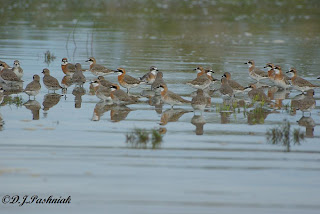
I slowly drifted in closer and when the kayak ran aground I slipped out and then approached a little closer by shuffling forward on my knees. Shorebirds are less frightened if the person approaching is not seen as so tall. By looking back at previous photos I think this is the closest I have ever been to these birds. Also many of them were going into breeding plumage and I have never got such good close photos of them like this. The birds were all at different stages of their moult into breeding colors.
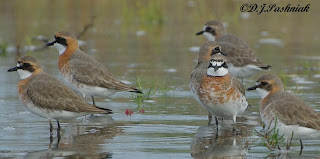
These two were not showing any color at all. The bird in the middle front is a Red-necked Stint which looks very small beside these others.
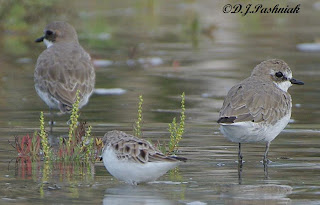
There is a Red-capped Plover out of focus in the right rear of this photo. It also is considerably smaller than the Lesser Sand Plovers.
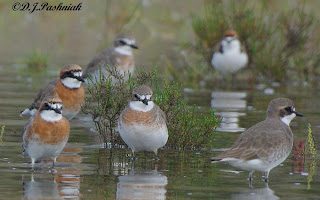
For more bird photos visit the Bird Photography Weekly.

Tuesday, March 8, 2011

Reflections

Mullens roost site is always beautiful on a high tide. Kayaking in there when there is no wind is especially beautiful.
The bay is very shallow and covered with saltmarsh plants which gradually go underwater as the tide comes in. The birds retreat from the tide until they are roosting up against the higher vegetation.
Saltmarsh plants are low growing and small shorebirds - such as these Lesser Sand Plovers - can be very hard to see amongst the plants. Several of these birds are beginning to show breeding colors. They get a dark red color down their front and around the neck.
Some of the birds continue to hunt around for food while the water comes around the plants. The birds and the plants make perfect reflections in the still water. These are also Lesser Sand Plovers not yet showing breeding colors.
These Red-necked Stint were perfectly posed around the small plants.
This post is for World Bird Wednesday.

Tuesday, February 22, 2011

Inskip - Smaller Shorebirds

This post is for World Bird Wednesday.

As well as extra high tides at the end of last week there were also extra low tides. It is only on the very low tides that I can walk out around the sand island at Inskip Point. I hoped that I might get some views of small shorebirds on the far side of the island - where I often find them. But - one can never be absolutely sure where shorebirds will go and there were none where I expected them. So I slowly walked back across the sand flats and looked for movement. These sand flats are huge and the birds are very small so when there is movement I slowly walk in that direction. With the sun behind me it is possible to get some good clear photos. All these photos are full crops. The water in the photos is only a few mm deep (possibly half an inch or less) but the sun at that angle makes a nice background.
This is a female Red-capped Plover. The bird book gives its size as approx. 15cm bill to tail. This bird is an Australian shorebird and stays here all year round.
This is a Red-necked Stint. The size is approx. 15cm bill to tail. However, it never appears quite as tall as the Red-capped Plover as it is usually moving over the sand with its head down looking for food. The Red-necked Stint is the smallest of the migratory shorebird. Its weight is approx.25gm.
This is the Lesser Sand-Plover. Its size is approx. 19-20cms. It is not easy to immediately tell the Lesser Sand-Plover from the Greater Sand-Plover since there is not a lot of difference in their sizes. Also a large female Lesser SP may be quite similar in size to a small male Greater SP. (As with many of the shorebirds the females are larger than the males.) The Greater SP has a longer bill than the Lesser. In non-breeding plumage the plumage colours are very similar. We never see as many Greater SP as Lesser SP and I did not see any that afternoon.
This is a Sanderling. Its size is approx. 20cm. This photo is not quite as clear as the others as I could not get into a position where the sun was directly behind me.
This is a Ruddy Turnstone. its size is approx. 23cm. These birds feast on the little crabs that are all over the flats. This bird has a bit of crab in its bill and is about to take pieces out of what is left of the crab in front of it.

Sunday, February 13, 2011

A Falling Tide

I always enjoy walking along the edge of the bay in the early morning and yesterday morning was particularly enjoyable. It was still cool enough that walking was enjoyable and there was a little breeze to keep the worst of the biting insects away. The tide had been high an hour or so before I got down there and the sand flats were beginning to be exposed. I had walked along to a little rocky inlet where the shoreline turns. I was looking to see if I could see the pair of Pied Oystercatchers that often sit out there when I realized that there were a lot of small shorebirds out there as well. The only problem about trying to see shorebirds that early in the morning is that the shore runs north and south so looking out over the bay is looking directly into the bright morning light. I walked out towards the birds and they were almost in silhouette against the light.
I slowly went closer but at an angle so that the light would be 'side on' and watched for signs that I was not disturbing them. I had just got into a good position and had taken a few photos which showed that they were mostly Lesser Sand-Plovers when there was a dog's bark from further up the beach and some more morning walkers passed along the beach behind me. Suddenly the birds all flew up and out across the water. There must have been at least two hundred in the flock. Most of them had been invisible hidden amongst the rocks.
I turned to go back closer to the shoreline when I realized that there was another group of birds on another sandbank that had come out of the water by this time. There were more Lesser Sand-Plovers as well as a number of Bar-tailed Godwits. It was interesting to see the difference in size between the two.
The tide was going out quite fast now across the sand flats and as it fell the larger shorebirds moved out into the water to hunt for food. Every now and then I could see their bills probing down into the water after some piece of suitable food. The exposed sand was still covered with a sheen of water and there was movement all over as the smaller shorebirds pecked at the soft sand.
If the weather stays calm then it should be perfect for kayaking in the same area in a couple of days time.
For more bird photos visit the Bird Photography Weekly.

Sunday, January 16, 2011

More Gray Days.

We've had several days of dry weather but unfortunately there are still lots of gray clouds around. When I walked out to the Mullens shorebird roost this morning and yesterday morning I saw lots of birds - but gray skies and gray/brown birds on gray/brown sand don't make for great photos.
There were lots of birds on the far side of the bay. The larger birds - Godwits and Curlews - were further down the bay where the water is deeper.
Many of the smaller birds were on a sand bank at the shallow end of the bay.
There were large numbers of Lesser Sand-Plovers in among the other birds. They were standing in the shallow water in front of the Bar-tailed Godwits.
They were also out on a sand bank with some Pacific Golden Plovers.
There was also a small flock of Great Knots.
There is still a lot of fresh water running into the bay from the recent heavy rains. This fresh water is stained with the vegetation it filters through and comes out colored dark orange/red. I am still trying to get a photo that shows all the tints of red as the water gets deeper out from the shoreline.
For more bird photos visit the Bird Photography Weekly.

Sunday, December 28, 2008

Bad Weather - Beaut Birding...

...and after all, what enthusiastic birder would let a little thing like rain put them off looking for birds! In one direction the clouds looked rather threatening -
- and in the other direction the rain was falling.
However, we only had to run back to the kayaks once to quickly find rain proof cases and covers for cameras and other gear.
The birding was certainly worth it. There were the usual large numbers of Bar-tailed Godwits and Eastern Curlew, but we had come out especially to see what smaller birds were also there. We found quite a large flock of Great Knots. This was the first flock we had seen here this season but it is such a large site that it is certainly possible we had just missed them. There were also flocks of Greater Sand-Plovers, Lesser Sand-Plovers, Red-necked Stints and Red-capped Plovers. The birding books give all the fine details to distinguish Greater from Lesser Sand-Plovers, but the best way is to watch them side by side as we were able to do today.
A mixed flock of Great Knots, Lesser and Greater Sand-Plovers, and Bar-tailed Godwits
Counting a mixed flock like this is a special challenge. Today we were just looking.
Red-necked Stints and Red-capped Plovers are such tiny birds but let you get quite close
before they show signs of being disturbed.