Showing posts with label Bar-taile Godwits. Show all posts

Wednesday, February 15, 2012

A Morning Walk

This post is for World Bird Wednesday.

I had another set of bird photos all ready to post for World Bird Wednesday - but - after an early morning walk down at the shoreline this morning I decided to try and show why I keep watching shorebirds.
I didn't get any great clear or close-up photos. It was just a beautiful morning and great to watch shorebirds going about their "birdy" business in a peaceful environment.
The sun came up and then disappeared behind a bank of clouds for a while.
The tide had been full before I got down there and as it started to fall the shorebirds flew in from their roost and began hunting for food in the shallow water and the soft sand. The first birds I saw were Bar-tailed Godwits.
I heard numbers of Eastern Curlews but these birds are never easy to get close to. This one flew in to feed close to some Godwits.
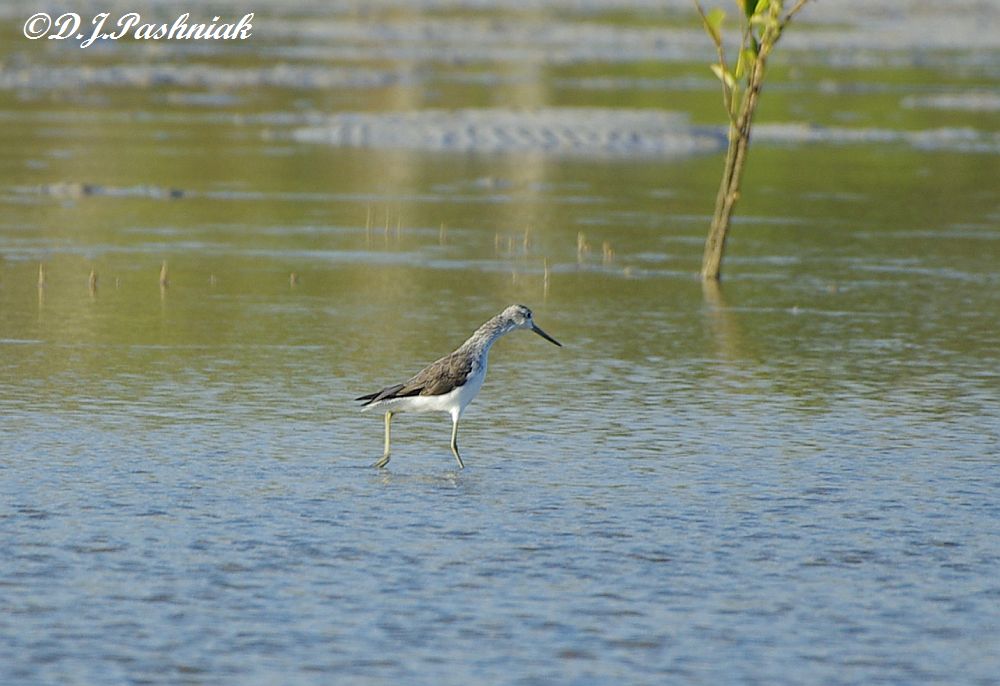
Further along the shoreline I could see a smaller bird busily dashing through the shallow water and then stopping to peck up whatever it had disturbed. I eventually got close enough to see that it was a Marsh Sandpiper.
This soldier crab ran away just ahead of me and then decided it would be safer to dig under the sand for a while.
The bush at the edge of the bay looked clear and crisp in the early morning light.
It was a great start to what promises to be another very hot day.

Tuesday, March 22, 2011

More Colors

This post is for World Bird Wednesday.

There were several thousand Bar-tailed Godwits (Limosa lapponica baueri) roosting at Inskip Point on the very early morning high tide last week. Many of them were showing beautiful red breeding colors. It is the males that get this lovely bright red all down their fronts. The females have just a faint wash of color and are more heavily barred. The red color will become even darker but I seldom see the really bright colors here.
The back of the bird also gets more intense color.
When I looked at my photos from the first morning I was out there I saw one dark red splash of color in one photo which I almost dismissed as another Godwit. However, when I looked the second time I realized this was a much smaller bird and by comparing it with others roosting near-by I realized I had photographed a Curlew Sandpiper (Calidris ferruginea) with red breeding colors. I had never seen one of these birds with such dark color. In the spring when they first arrive here they have red splashes of color down the front - but this was a bird with all-over red! I had to go back the next day and try to see it again. Curlew Sandpipers have a bad habit - from the point of view of the birdwatcher! - of roosting right in among the Godwits and often all you see are a smaller set of legs in behind! I took friends out with me the next morning and we stood and watched and photographed the birds for a long time before we saw any Curlew Sandpipers at all. However, it was worth the wait. The whole flock started moving as the tide went out and we saw a number of birds with quite a lot of red down the front.
Curlew Sandpipers in front and Godwits behind.
Curlew Sandpiper in front then Great Knots and Godwits behind.Bar-tailed Godwits breed in Alaska.
Curlew Sandpipers breed in the high arctic tundra from Siberia west.

Wednesday, January 13, 2010

Birds and Mangroves

I kayaked over to the Carlo Island roost site yesterday. I wanted to see if I could find a way through the mangroves to the other side of the Whimbrel roost and also to the north side of the bay where we went in a 4 wheel drive vehicle last month. No, I could not get to the other side of the Whimbrel roost but, Yes, I found a way to the north shoreline.
There are a number of different mangrove varieties in this area with quite different growth habits in different areas.
The mangroves where the Whimbrels roost are quite distinctive. They don't have rounded crowns as most mangroves do but almost look to be broken off at the same height - although there are some higher branches where Whimbrels roost and watch for any disturbances. There are thick stems/trunks visible so they are not just young trees. There is new healthy growth all through the area so they are not dead or dying trees. It is only in the roost area that the trees are like this. Surrounding areas have larger well-shaped trees as well as much smaller and younger trees. I would be interested in any opinions as to the reason - from those who have more knowledge about mangroves than I do.
When I kayaked through the mangroves to the north shoreline I found the Godwits and Eastern Curlew were roosting in the shallow water at the edge of the bay. I stayed well away so I didn't disturb the birds - the Godwits stayed where they were but some Eastern Curlew flew.
I saw a number of Orange Mangroves (Bruguiera gymnorhiza) with both flowers and fruit on them. The red colored flowers made a nice contrast with the dark green leaves.
Next to these Orange Mangroves were some with white flowers (not yet open) and much longer fruit - Red Mangroves (Rhizophora stylosa) I think - although I am still having trouble identifying some of the mangroves.
While paddling slowly and quietly through these mangroves I saw a Striated Heron. This one let me get quite close without showing any signs of being disturbed. It turned and looked me over and then went back to looking the other way.
The round trip was a bit over 6 kilometers and the hardest part is always getting the kayak back up on the car! This photo is looking from the Carlo boat launch back towards Tin Can Bay.

Sunday, December 28, 2008

Bad Weather - Beaut Birding...

...and after all, what enthusiastic birder would let a little thing like rain put them off looking for birds! In one direction the clouds looked rather threatening -
- and in the other direction the rain was falling.
However, we only had to run back to the kayaks once to quickly find rain proof cases and covers for cameras and other gear.
The birding was certainly worth it. There were the usual large numbers of Bar-tailed Godwits and Eastern Curlew, but we had come out especially to see what smaller birds were also there. We found quite a large flock of Great Knots. This was the first flock we had seen here this season but it is such a large site that it is certainly possible we had just missed them. There were also flocks of Greater Sand-Plovers, Lesser Sand-Plovers, Red-necked Stints and Red-capped Plovers. The birding books give all the fine details to distinguish Greater from Lesser Sand-Plovers, but the best way is to watch them side by side as we were able to do today.
A mixed flock of Great Knots, Lesser and Greater Sand-Plovers, and Bar-tailed Godwits
Counting a mixed flock like this is a special challenge. Today we were just looking.
Red-necked Stints and Red-capped Plovers are such tiny birds but let you get quite close
before they show signs of being disturbed.