Sunday, October 30, 2011

Crested Terns

This post is for the Bird Photography Weekly.

Crested Terns are coming in to breeding plumage and getting ready to fly off to the off-shore islands where they will breed and raise their young. I watched these ones the other day - in full breeding plumage - strutting around among a flock of other terns. Their crests were raised as part of the display they were putting on.

Wednesday, October 26, 2011

Mainly Godwits

This post is for World Bird Wednesday.

I was delighted to find a huge number of birds all roosting on the Point at Inskip yesterday morning. When I go out with my camera I do not try to count. I cannot do both! I can only estimate that there were well over a thousand birds and there could well have been double that number. Most of the flock were Bar-tailed Godwits. They were strung out along the water line and then packed in solidly behind that. Many of the birds were standing out in the shallow water and as the tide came in and the water got deeper there was constant movement.
It was very interesting to see good numbers of juvenile birds. Their plumage is quite distinctive but they only keep it for a short time after they arrive out here in Australia. The bird on the right of the photo is a juvenile.
I think one of the prettiest parts of the Godwits' plumage is the under-wing patterns.
When I first started looking at the flock of birds I thought there were only Godwits. However, after a while I saw that there were numbers of small birds standing right under the legs of the larger Godwits. Unless they were at the front of the flock they were almost hidden. The smaller of the birds are Curlew Sandpipers and the slightly larger ones are Great knots.
In many places these smaller birds were packed in so tightly it was impossible to count individual heads.

Tuesday, October 25, 2011

Boats and Birds.

This post is for NatureFootstep Waters

I went out to Inskip Point soon after sun-rise this morning. I hoped that I would see shorebirds roosting on the Point - IF - I got out there before too many people started walking around. I was lucky - there were several thousand birds roosting on the sand. This is one end of the flock that was furthest out on the Point. (More about them tomorrow when I have had a chance of going through all the photos I took.)
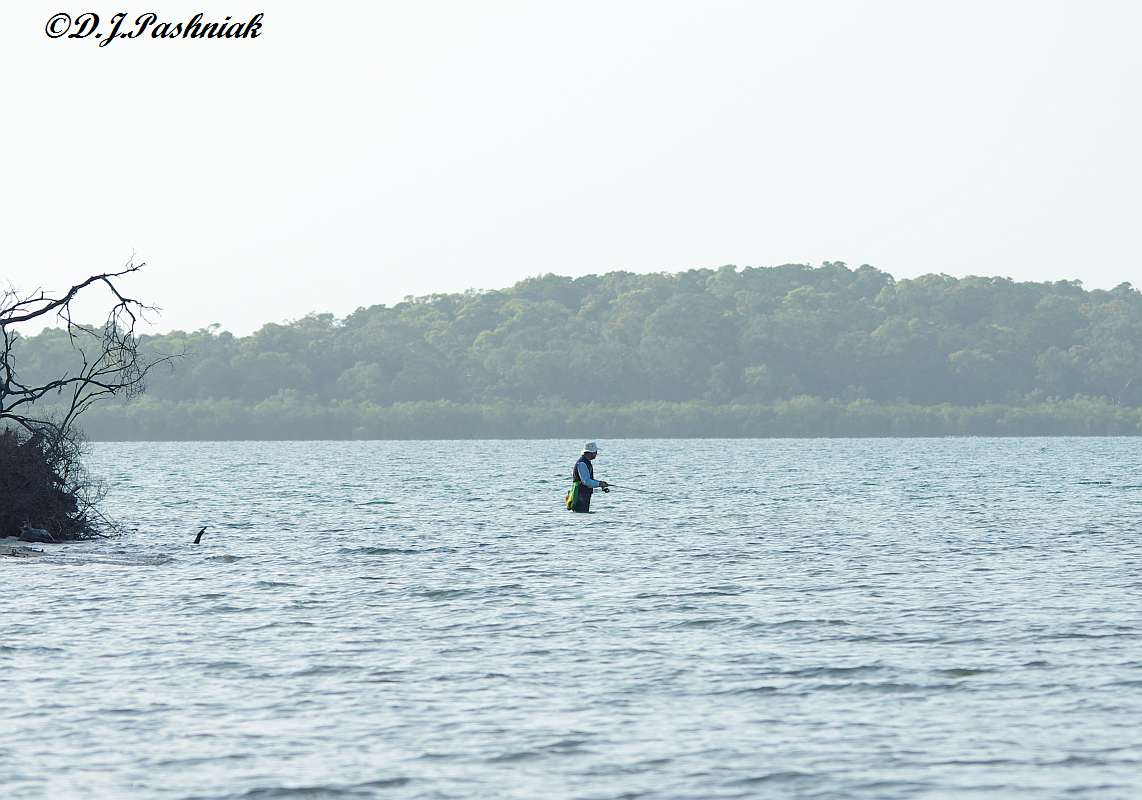
I got out there even before the barge for Fraser Island had arrived. However, it is never too early for a fisherman to start trying for a big catch!
The barge came across from Bullock Point soon after but it went straight over to Fraser Island where there were vehicles waiting to come back.
There were several small fishing boats speeding across the water. This one went very close to the sand island and disturbed all the birds from out there.
This one came past the Point a little later and the birds did not disturb at all.

Sunday, October 23, 2011

Early Morning

This post is for Scenic Sunday and Bird Photography Weekly.

I went walking very early this morning around to the Mullens roost site. Although the tide was right in it was not very high and there was more sand than water right in the roost site.
As I walked along a Great Egret (Ardea alba) flew up then settled down again a little ahead of me.
I walked slowly towards it and it kept right on looking for food in the shallow water.

Wednesday, October 19, 2011

Crab Creek (2)

For more photos of birds go to World Bird Wednesday.

With a variety of different habitats Crab Creek usually has a good variety of shorebirds. Different species of birds seem to prefer different places on the roost - although sometimes they are all mixed up together in one large flock. On days like that I assume they have been disturbed some time before I arrive to watch them. There are Brahminy Kites, Whistling Kites, and Ospreys nesting around the area and these birds always disturb the shorebirds if they fly too close overhead.
The mangroves lining the creek itself are used as a roost for Whimbrels. They usually prefer the trees between the third and fourth entrances into the roost.
At the northern end of the roost there are a number of Grey Mangroves. These trees have branches that are more open and while providing shelter for the Grey-tailed Tattlers also allow them clear views around to watch for predators - or humans that accidentally come too close in kayaks! The Grey-tailed Tattler I photographed the other day still had quite a lot of breeding plumage down its front.
Common Greenshanks are often found on a small sandbank at the northern end of the roost. If they are disturbed from there they usually fly to the north-eastern side of the roost where there is an open area of grass and saltmarsh plants and they have good clear views of anyone approaching. There are only small mangrove plants in this area which don't restrict the views.
Further down this side of the roost there is another clear area of grass and saltmarsh plants and this is the area preferred by the Eastern Curlews.
Godwits use the sandbanks closer to the water. They can also sometimes be found on the sandbanks right at the southern end of the roost. Red-capped Plovers, Red-necked Stints and Pacific Golden Plovers prefer areas of saltmarsh where the plants are just tall enough to give them some cover when they sit down to rest.
There are usually a couple of pairs of Pied Oystercatchers on the roost. One pair prefers the southern end and the other the northern sandbanks.
When I did a count of this area a couple of days ago I saw Whimbrels, Godwits, Eastern Curlews, Common Greenshanks, one Marsh Sandpiper, Grey-tailed Tattlers, Pacific Golden Plovers, Red Knot, Red-capped Plovers, Pied Oystercatchers, Little Egrets, White-faced Herons, and Masked Lapwings for a total of 394 birds.

Tuesday, October 18, 2011

Crab Creek

This post is linked to the new meme of NatureFootstep Waters.

Crab Creek is at the southern end of Tin Can Bay. Dense mangroves line both sides of the creek. Behind the mangroves on the southern side of the creek is a large area of open shallow water and sandbars which the shorebirds use as a roost site. There are four entrances from the creek. The first entrance is immediately opposite the boat ramp and is used as an anchoring area for boats. All photos enlarge when clicked on.
The other entrances are well-hidden narrow passages and give no idea of the extent of the waterways and sandbars in the area. (This photo is also taken looking out toward the creek.)
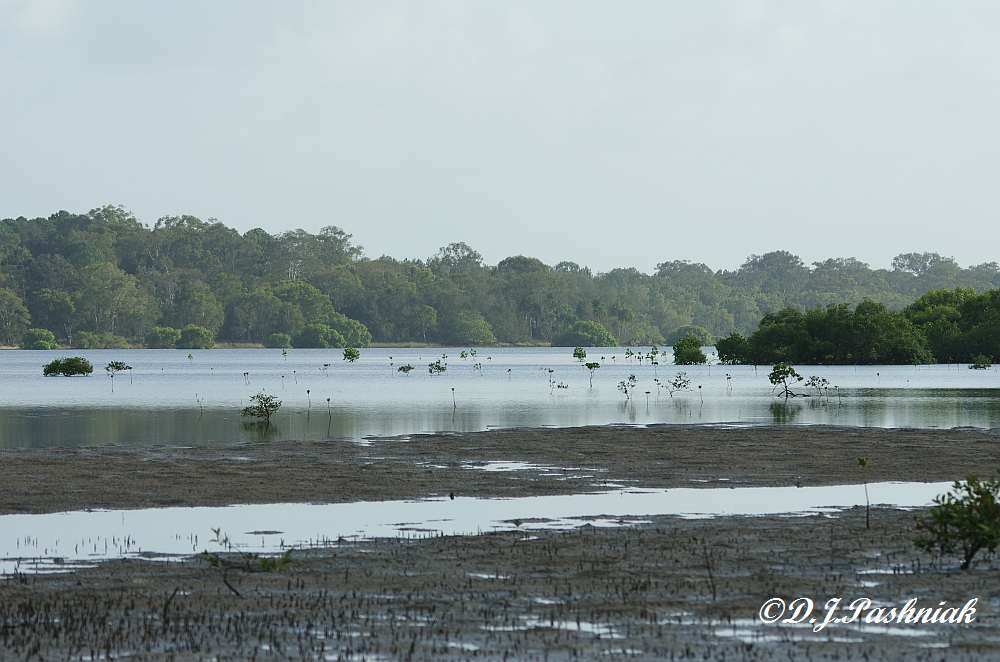
The main area of water stretches for quite a distance behind the sheltering mangroves.
There are other more shallow areas that end in thick grasses and sedges right under the taller trees.
Even without seeing shorebirds, it is a beautiful place to kayak.
I will post tomorrow about some of the shorebirds I counted at this roost the other day.

Monday, October 17, 2011

Kookaburra

This post is for the Bird Photography Weekly.

Kookaburras are always fun to photograph but the other day this one flew down onto the grass in front of me and gave me a great view of the color and pattern of the feathers down the back and tail.