Wednesday, May 12, 2010

Crested Tern EXTRA

Crested Tern EXTRA
(This is so interesting that I couldn't resist using some color to make it eye-catching)
When I posted the photos of the Crested Terns earlier in the week I knew that the birds in breeding plumage at this time of the year did not fit the pattern of what I have seen until now. Crested Terns breed down here approx. Dec-Feb - so what were these two birds doing in breeding plumage at the 'wrong' time of the year? I contacted Jill Dening and asked for her opinion. She contacted others and received back information about a trip made out to the Swain Reefs (out from Mackay) by people from DERM during July 2009. They observed and photographed colonies of Crested Terns nesting and with young at this time. The birds that I observed in breeding plumage out at Inskip Point the other day possibly came from a northern population which breeds at the opposite time of the year from the ones we usually see here in southern Queensland.
Just another small piece of information to add to our current knowledge.

Orchids

I have a friend who lives not far from me with an interesting yard. Her yard backs onto a nature reserve and when she had the house built she retained as many of the trees and shrubs as possible. (This is the same lady who had the Tawny Frogmouths nesting in her yard.) She has allowed the small grasses and shrubs to grow up as well and only weeds out the non-native species. She contacted me the other day to say that she had discovered some orchids flowering in the back yard and would I like to take some photos. I always admire the beautiful orchids that Denis over at Nature of Robertson posts about. He has suggested to me that there must be similar orchids growing up here and I should try to find some.
Little did I know the hazards attached to photographing orchids growing so close to the ground and under other vegetation! I got down on hands and knees and shuffled through the undergrowth to get where I could photograph the flowers. I got caught on a low branch and my shirt will never look the same again! When I stood up I found that the litter on the ground had scratched my legs and there was blood dripping from a number of places! The final problem was that I could not get the camera settings right and had to go back the next morning to do it all over again! This time, however, I put on an old shirt and took a good big sack to put on the ground and save my legs from all the things that scratched the previous day.I sent off the photos to Denis for ID and he said it was a species he had posted about last January - the Bonnet or Tartan Orchid (Cryptostylis erecta). I did read that post and thought at the time that the flower was so distinctive that I would recognize it if ever I found it up here - but obviously you have to get your eye in for orchids! (Thanks for all the help Denis.) There were a number of these rather long leaves around the trunk of an old banksia tree. Denis says that each plant has only one leaf so there must be quite a number of plants growing close around the tree trunk. I looked for the purplish color underneath but found it showing only on the smaller younger (?) leaves.The flower stem had a number of buds at the end of the stalk but I could only see one flower open at a time.The flower is beautiful! I was surprised at the slight differences in color between the various flowers. I wonder if the color deepens the longer the flower is open. It seemed to me that the flowers which had just opened on the second day I was photographing were paler in color.P.S. I have a lot to learn about photographing orchids!

Sunday, May 9, 2010

Crested Terns

Out at Inskip Point today there was a group of Crested Terns (Sterna bergii) in all stages of plumage. There were plenty of juveniles in mottled plumage, scruffy looking adults part way through a moult and even a couple of adults in almost full breeding plumage.
Juvenile on the left, adult on the right and a couple of Silver Gulls in front.
Two adults in almost full breeding plumage in the front.
A juvenile in flight.
Rainbow Beach is south of Inskip Point and I decided to go up to the Sand Blow which is only a short distance from the town. There are tall sand cliffs between Rainbow Beach and Double Island Point. These cliffs are constantly eroding and at this point they have created a 'sand blow' from the sea side well over onto the land on the west. The sand is constantly moving and encroaching further west.
Looking across the sand blow. People walking across give an idea of the size of the sand.
Looking east towards Double Island Point.
Looking west - part of the town of Rainbow Beach is in the foreground, Carlo Creek with boats at anchor is on the right in the middle of the photo and boats at anchor near Tin Can Bay in the background.
For more bird photos visit the Bird Photography Weekly.

Wednesday, May 5, 2010

Carlo Island Roost Site

The weather and tides were good last week and I was able to kayak around to the roost site that the QWSG (Queensland Wader Studies Group) calls the Carlo Island Complex. I was joined by friends who are more knowledgeable than I am about the mangroves. They are part of a group that are monitoring mangroves in the area as part of an on-going study for the University of Queensland. They hadn't been into this area before and I hoped that they might be able to find some information about the rather strange growth habit of the mangroves where the Whimbrels roost.
We kayaked around in this area where the Whimbrels roost during the summer and saw no shorebirds at all. Then we went on further to the northern part of the bay and checked there for shorebirds as well. This small boat was lying on the sand among the mangroves. It was broken up and we wondered if it had drifted in here after some of the big storms and high winds we have had recently.
We saw very few shorebirds in this area either - just some Little Egrets and a couple of Pied Oystercatchers.
The birds disturbed when we got out of the kayaks and walked around on the shoreline to check for any more birds. When we kayaked back towards Carlo we found them roosting on another part of the shoreline. We had heard a Common Greenshank when we first kayaked into the area but had not then seen it. Now it was roosting with a group of 9 Little Egrets and the 2 Pied Oystercatchers we had seen earlier.
We saw no shorebirds apart from these few birds. During the summer this area is a roost site for large numbers of migratory shorebirds. Now I am wondering if the roost is not used by migratory shorebirds during the winter at all. (Some migratory birds stay all year - either the ones too young to migrate yet or old and unfit birds.) This roost is monitored very seldom because the access is so difficult unless you come in by kayak. There are too few people counting for the QWSG and the bay is a very large place. However, it was interesting to find another pair of Oystercatchers as these birds always use the same small portion of the shoreline on which to roost. I have watched pairs of Pied Oystercatchers in exactly the same places for the 7 years I have been living here. Apart from these resident birds we do get quite large groups that come in and stay for a few weeks then take off again. This photo was taken in January of 2009.
Kayaking back to the Carlo boat launch area there are good views across the bay to Tin Can Bay. Sitting down in the kayak gives a different perspective on the bay. You seem to be surrounded by an immense area of water and even the sky is a long way off!

Sunday, May 2, 2010

Birds in the Park.

I went into Gympie last week to do some business that can't be done out here in Cooloola Cove. (Gympie is about 55kms from here and our closest city.) I took my camera and went to the park to see what birds might be there that I don't see at home here. There is a lake in the park with fountains that usually attract all sorts of water birds.Last time I went there I also saw numbers of Little Corellas (Cacatua sanguinea). They were still there up in the trees and also down on the grass. This is one bird that we don't see out here and I am rather glad because they are very noisy! My bird book describes them as being 'very vocal' with 'loud screeches' which are 'deafening where large flocks occur'.There were numbers of Dusky Moorhens (Gallinula tenbrosa) out on the lake. These birds have red legs - the color shows faintly under the water. They were also making a lot of noise and I managed to get a photo of one with its mouth open squawking at me. For more bird photos visit the Bird Photography Weekly.

Tuesday, April 27, 2010

Beautiful - but frustrating!

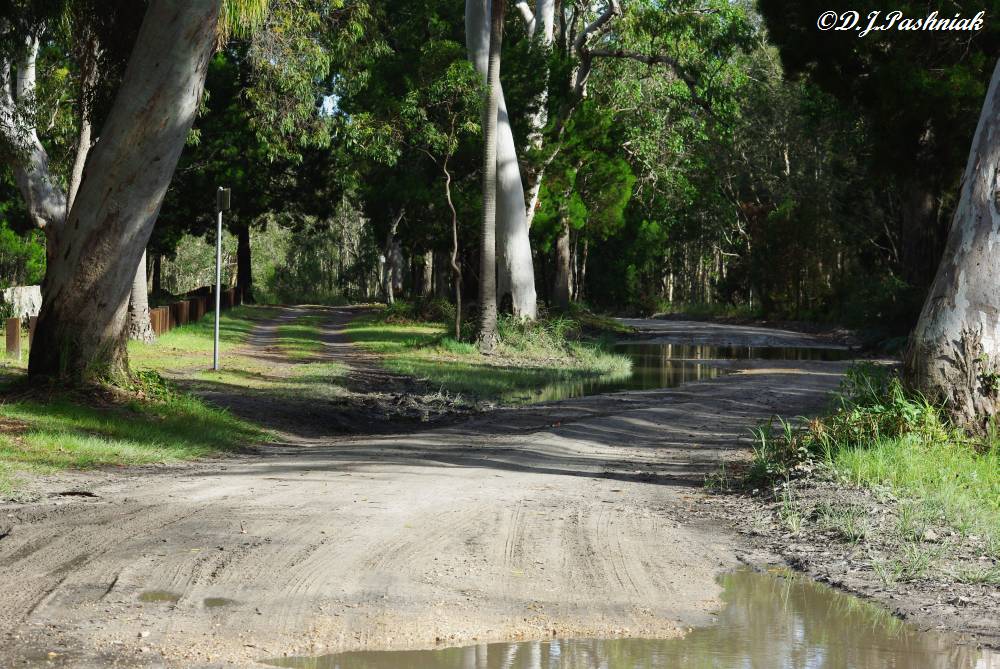
I went out for a kayak on the bay yesterday morning. When I left the water was very still but by the time I started back it was a struggle to paddle back against the wind. I saw some interesting shorebirds - but the frustration came in because I forgot to compensate for the glare off the water and so the photos are good for record shots only. Most of the shorebirds were in non-breeding plumage so I am assuming that they will be staying here all winter. There were good numbers of Godwits and Eastern Curlews and a few Greenshanks and Stints. The surprise were the numbers of Grey-tailed Tattlers which were showing quite a lot of breeding plumage. Maybe some of these will be migrating soon. I must look up my records but I seem to remember these leave later than most of the other migrants. There were also Red-capped Plovers everywhere. I got in quite close to the birds roosting on the shoreline by drifting in on my kayak and as I got in closer I stretched out and lay down sideways to decrease the height that the birds saw drifting towards them. It works well! and is a trick I learned from a visiting friend who showed me how beautiful and peaceful it is to do this out in the middle of the bay on a calm morning! (Thanks Dawn!!) The only bird photograph that was OK was this Silver Gull that flew close overhead. They are common - of course! - but beautiful.We have had a lot of rain over the last couple of weeks - none of it really heavy but quite constant and the result is a lot of water sitting in the low spots. The road down to the Mullens picnic area is seldom smooth or well looked after but I did wonder if the low spots would be too wet to drive through. Obviously others decided the same because there is a new track well above the road. I'm glad I could drive down there - but it would be nice if the original road were better cared for.This boat was anchored close to where I put the kayak in. I did wonder why he wasn't getting out of there on the high tide but maybe he decided the wind was bad enough that he should stay put. The afternoon low tide showed just how shallow the area is.

Sunday, April 25, 2010

Pigeons and Doves

When I first came here to live there were Crested Pigeons everywhere. Then a couple of years ago I saw the first Spotted Turtle-Doves. These are not native to Australia but were introduced and can replace the native species. I saw fewer and fewer Crested Pigeons while the others were always somewhere around the yard. - Spotted Turtle-DoveLast Friday (in a brief spell of fine weather!) I saw Crested Pigeons roosting on the electricity wires going in to the neighbor's house. I counted 18 in all - sitting in several groups along the wires. This was one group.They watched me come out with my camera and gradually move closer. Some looked at me from one side and some watched from the other - some simply looked bored as if they wished I would leave!At least I now know that their numbers are not decreasing around here - even if they are not in my yard so frequently.
For more bird photos visit the Bird Photography Weekly.