Showing posts with label Scarlet Honeyeater. Show all posts

Sunday, September 4, 2011

Scarlet Honeyeater

This post is for the Bird Photography Weekly.

The other day my friend Janet phoned to say she had Scarlet Honeyeaters (Myzomela sanguinolenta) feeding in her Callistemon bush and would I like to come and get some photos of them. I have never had these birds in my yard, but my friend's yard backs on to some undeveloped land which at present has a thick growth of tall grass and shrubs and trees. The smaller birds can find lots of hiding places in there and can then fly into the yards that back onto this area.
I have taken lots of photos of Scarlet Honeyeaters before - and have even posted a few on this blog - but my previous photos have shown a beautiful scarlet color gainst the blue sky but no detail of the birds. This time I was really up close!
These birds are tiny - 10-11cms or about 4 inches. They were flying in and out of the bush and climbing all over the flowers to feed. Often they were completely hidden by the leaves and flowers but then it was just a matter of waiting until they chose another flower where I could see them properly.
Special thanks to Janet for phoning to tell me about these birds!

Tuesday, July 26, 2011

Mullens in the Morning.

This post is for World Bird Wednesday.

It was low tide the other morning when I went for a walk along the foreshore to the Mullens roost. I wanted an easy walk without having to carry a lot of weight so left the big 150-500mm lens at home. Oh well, we all make mistakes of that kind sometimes! There were small birds everywhere in the bushes and trees and the 70-300mm lens was just not long enough!
Because there is still a lot of blossom on the Paperbark trees there were numbers of honeyeaters around. The easiest to see in that area are the Mangrove Honeyeaters. This one stopped just long enough for a quick photo even though the light was not in the right direction.
There were also lots of Brown Honeyeaters flying around.
There were a number of other small birds flitting in and out of the Mangroves that are all around the edge of the salt marsh. I waited for quite some time hoping that one would stop where I could actually see it rather than just fly into the bushes where I could only see leaves moving. This is the best I did - not a clear photo of the bird but unmistakeable with that pale ring around the eye - a Silvereye.
The biggest surprise of the morning were a group of small waders that flew up ahead of me then dropped down into the saltmarsh plants again. I couldn't tell what they were just from their flight pattern but even a distant photo was enough to ID Black-fronted Dotterels. These are another of the small shorebirds that are resident in Australia. They are not common in this area although I had been told that there were two there a couple of months ago. There were at least 4 in the group I saw. I took better photos of one I saw out in SW Queensland last year and have posted that photo again.
The most colorful photo of the morning was of a Scarlet Honeyeater that flew high up into a dead tree and then sat up there and let me get a couple of distant photos against the deep blue of the sky.

Sunday, July 3, 2011

Scarlet Honeyeater

This post is for Bird Photography Weekly.

It was a beautiful day for a walk along the foreshore at Mullens but a brisk wind meant that the small birds weren't sitting around out in the open. I could hear them back in among the trees but it is thick bush and not easy to see any small birds.
I was interested to see that a pair of Masked Lapwing have apparently claimed the little rocky island as their own.
This used to be a territory occupied by a pair of Pied Oystercatchers but the Masked Lapwings would be aggressive enough to chase almost anything else away. I saw only one Pied Oystercatcher and it was standing well away from the shore on rocks that were only just out of the water.
Around the corner into the area of saltmarsh I was out of the wind but the birds were still well back in the bush. I saw a flash of scarlet and followed slowly until I could see up into the tree where the bird had gone. It was a Scarlet Honeyeater (Myzomela sanguinolenta) - a beautiful bird but always very active. It was up high in a casuarina tree and almost out of reach of even my big lens. It was feeding on mistletoe flowers. Now if I could only take the best bits out of all these photos I would really have a great photo of the bird!

Wednesday, June 30, 2010

Early Morning Birds

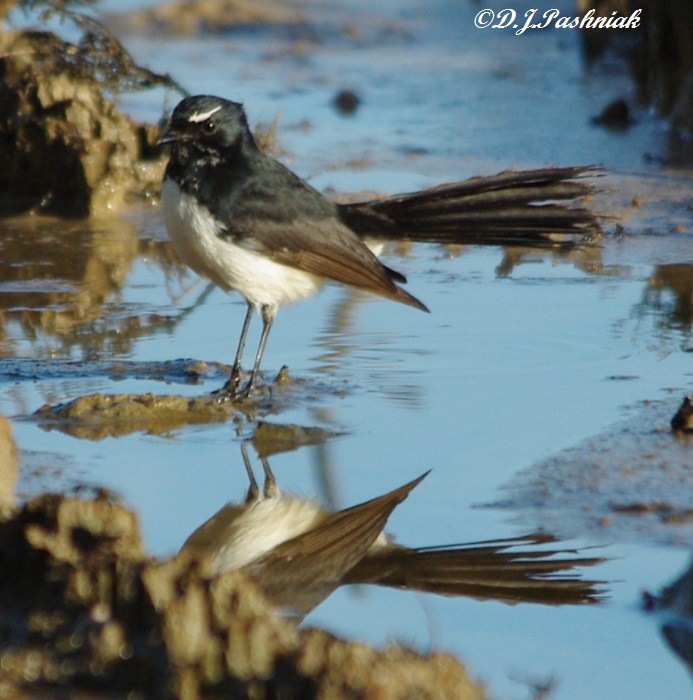
There was a heavy shower of rain just before I went for a walk along the shoreline the other morning. All the trees and bushes were still very wet and it seemed that the birds had used the rain as an excuse to delay their early morning preening. This Mangrove Honeyeater was intent on getting every feather into place.High up on a tree a male Mistletoebird also completed his morning preen.Out on the saltmarsh flat this Willy Wagtail was catching insects that were hovering over a puddle of water in an old vehicle track.The Scarlet Honeyeaters were already busy in the tops of the trees.The only shorebirds were small dots far out on the sand flats.

Monday, June 8, 2009

Wrens and Honeyeaters

Yesterday afternoon the morning clouds and rain moved out to sea and it turned into another perfect day. What could be nicer than to go out looking for birds with good friends who just happen to be expert birders! (Thanks Neil and Kel!)
The highlight of the day was this little female Red-backed Wren that was busy hunting around in the grass. You can see how tiny she is by the stems and blades of grass that she was hunting among. The caterpillar or grub that she caught almost looks too big for such a tiny bird.
The male Red-backed Wren was also around - but not nearly so easy to photograph successfully.

There were also a number of honeyeaters high up in the trees among the Paperbark flowers. The Scarlet Honeyeaters have eluded me until now - but they were still too far away to give really good clear views.

For great bird photographs visit the Bird Photography Weekly.