Showing posts with label Pied Butcherbird. Show all posts

Tuesday, January 18, 2011

Garden Birds

This post is for World Bird Wednesday.

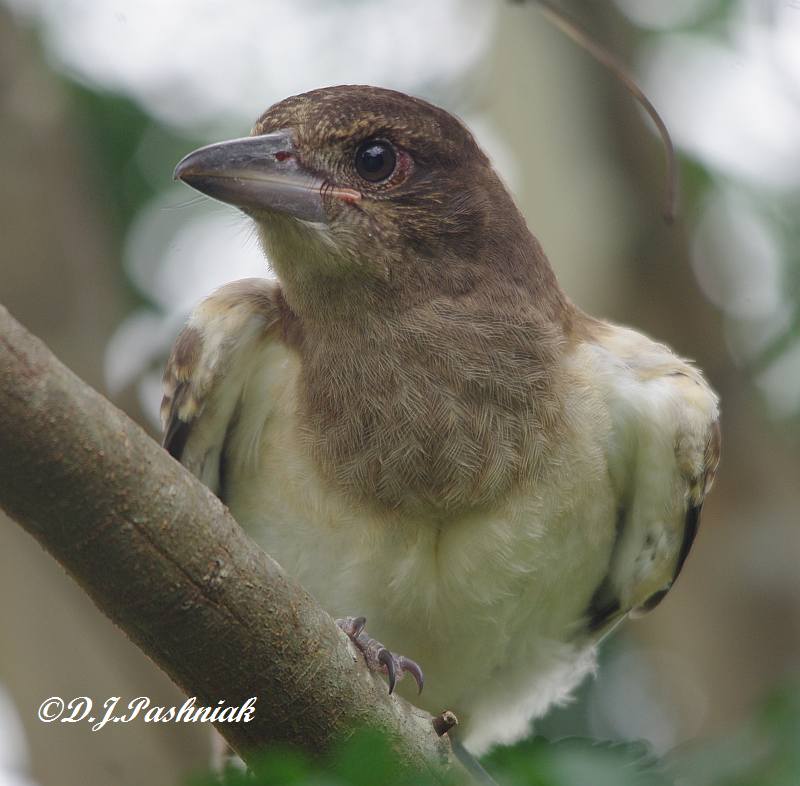
Over the last few days I have been hearing the sounds of young birds in the trees at the back of my yard. When I went out to investigate the other afternoon I found two young Pied Butcherbirds (Cracticus nigrogularis) sitting up in the tree. The adult bird flew off as I appeared but the two youngsters sat and watched me with what appeared to be great interest.
(Butcherbirds catch and eat anything smaller and slower than themselves and often hang it up on a small branch and eat it held in this position.)
After watching me silently for some time one of the young birds began to sing a few rather tentative notes of the adults' song. A young Blue-faced Honeyeater (Entomyzon cyanotis) did not like these two young birds so close to territory that it claimed for itself and came down into the same tree and gradually hopped closer.
(Blue-faced Honeyeaters can be most aggressive. They usually act as a group/pack and swoop and attack in a massed group! They have my cat completely terrified and she flees immediately they find her by herself in the yard. When they try these same tactics on the dog, however, she takes it as permission to attack the attacker! It ends up with the birds sitting out of reach and scolding while the poor dog dances around underneath!)
This bird was a young one as the two patches over its eyes were still a greenish color rather than the bright blue of the adult. It hopped down the tree. It peered down from the branch above and clicked its beak aggressively. It eventually even perched on the same branch. The Butcherbird ignored it, and, without the group to help it, the Honeyeater eventually gave up and flew off.

Sunday, July 4, 2010

Pied Butcherbirds

...Plus a few others!
I took all these photos while visiting friends this morning. Their garden is quite different from mine as all the big old trees were retained when the house was built. There are a number of Scribbly Gums with interesting looking holes in the trunk which birds use for nesting. This hole was being investigated by first a Yellow-tailed Black Cockatoo and then a Sulphur-crested Cockatoo. Unfortunately that was yesterday - when all the best stories happen! - so no photos.Last year a pair of Pied Butcherbirds raised a couple of young ones and they are all still around the yard. The juveniles are now nearly one year old but their plumage is still very different from the the adults'. The adult is all black and white but the juvenile is a mixture of gray and brown with the white.There were Kookaburras up in the trees but when I tried to get into a better position to photograph the blue specks down the back of the bird it kept moving around on the branch to keep facing me all the time.Rainbow Lorikeets were in one of the flowering trees. Their green color was a good match for the leaves. Like many parrots they frequently rip up what they are eating.Thanks Sarah and Graham for an enjoyable morning.
For more bird photos visit the Bird Photography weekly.

Monday, November 24, 2008

Pied Butcherbird

For great bird photos visit the Bird Photography weekly.

This is a common bird in my backyard. My bird book calls it an "outstanding songster". However, it is because of its habits in catching and killing prey that it gets its name. It will eat insects, lizards, small rodents, and small birds. When the prey is too large to manage it will wedge it in a tree fork or on a thorn and then stand back and tear it apart with its hooked beak.
Thanks Denis for a link to the call of this bird. The link is in mp3 format.

Early morning and feathers all fluffed out.
A few minutes later and feathers all in place.

Friday, July 11, 2008

Noisy Birds

Yesterday the predicted cold weather arrived from down south. Before the sun rose there was even a touch of frost on some dry grass next door. When the sun got up high enough to warm things up a little, every bird in the neighbourhood seemed to want to comment on conditions.

The Rainbow Lorikeets were around and as noisy as they usually are. I heard Noisy Friarbirds and had a brief look at some Spangled Drongos before they flew off. The Figbirds were making a lot of noise in both the big pine tree next door and also out on the power lines beside the road.

Male Figbird

A juvenile Pied Butcherbird joined the group on the wire.

The noisiest of all were the Blue-faced Honeyeaters. One juvenile, especially, sat and simply screamed for some adult to come and feed it. As soon as it had been fed it started the same noisy behavior again.

Juvenile Blue-faced Honeyeater

Blue-faced Honeyeater

A Kookaburra was sitting in the big pine tree next door and apparently objected to the noise. It hopped closer to the noisiest youngster in the tree – and was immediately mobbed by a whole group of birds until it flew off with a disgusted squawk. The Blue-faced Honeyeaters are such aggressive birds. I have frequently seen them mobbing and chasing off both cats and dogs.

Kookaburra