Tuesday, September 29, 2015

Inskip

What an interesting week this has been with the name "Inskip" written across the world media! We have had another "washout" at Inskip and this time it took out part of a camping area - complete with 4 wheel drive, caravan, camping trailer and assorted tents and camping equipment! It happened in the middle of the night which made it extra scarey for all the campers around.
This is not the first "washout" that we have had at Inskip but it is the first one that took property with it. I have counted five such washouts since I have lived here. The first one I photographed was in 2011 - a few days after it happened so the steep edges have had a chance to start to fill in.

There was another similar one in 2012 and very close to the previous one. This one nearly took the road to the end of the Point.

The one I found the most spectacular was in 2013 and half the area of the sand Point washed away in a very short time. I posted about it here.
This time it made the headlines because there was property lost and so many people involved. Before it started to wash away the edge of the sea was a couple of hundred meters from the camp site. This all happened late Saturday night and I went out and photographed it yesterday - Monday. It appeared that the 4 wheel drive had been pulled out of the water - and possibly the camper trailer - but the caravan was still lying in the water and gently rocking on the tide! I need to make a correction! Everything settled down into the soft sand! The next day they managed to pull out the camper trailer but the 4 wheel drive vehicle is still down there somewhere!

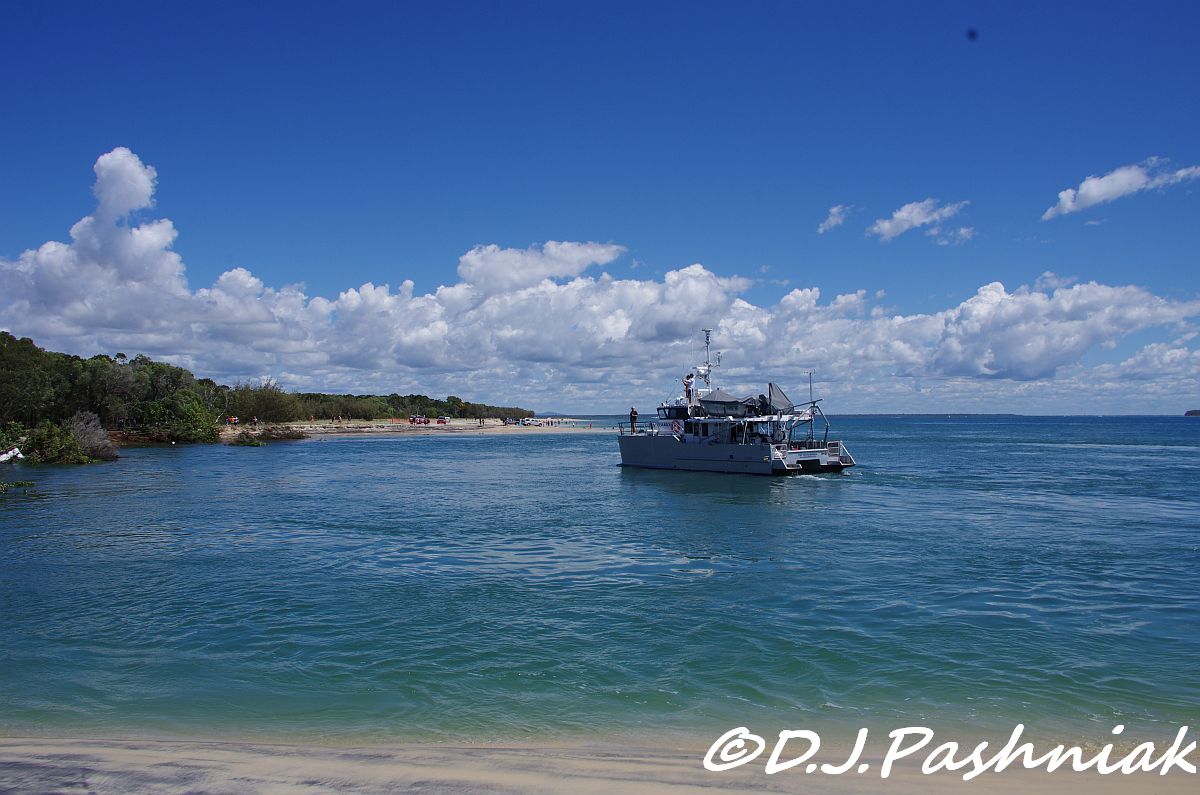
I had been out to Inskip last week to see what shorebirds were around but there were so many people and cars around that the only shorebirds were out on the sand island. This was at 6:30 am! (How could I have forgotten it is school holidays right now??!!)

The only good photo op was a pelican - but there are only so many pelicans I want to photo!

I set off for home but decided to take a quick trip down to Bullock Point which is on the opposite side of the bay. It seemed as if I was out of luck there as well and I was about to drive off when I looked up onto the big mast of a boat that was tied up to the shore. This boat has been there for quite a while and it appears that the people are not living on it right now. Anyway - this beautiful Sea Eagle (Haliaeetus leucogaster) was quite comfortable resting there. This is a young bird as the feathers are more brown  than grey.

For more scenery from around the world visit Our World Tuesday

and for more birds visit Wild Bird Wednesday


Tuesday, September 22, 2015

A Walk at Mullens

This is the beginning of the walk along to the bird roost at Mullens. When I came here 12 years ago it was possible to drive quite a bit further along the shoreline. Then "someone" - "officials" - "council" - or whoever! - decided that it would be better to block off the last couple of hundred meters of the track and let the vegetation regenerate. Accordingly bollards were placed over the track - AND - were pulled out! The ground after all is mainly sand! This happened more than once until some clever person decided to put big old pieces of logs between the bollards. These could not be removed easily - and so the bollards have stayed and the vegetation has regenerated! Since then another couple of hundred meters of track have been taken back and all vehicles must now tuck themselves tidily into the much smaller parking area!
As I walked along the shoreline I noticed quite a few trees have fallen down onto the sand and into the water at high tide.

I walked right along to the shorebird roost but it was not a very high tide and I did not see any shorebirds along there. This Pied Oystercatcher was close to the beginning of the walk. It is unusual to see a single bird by itself although there are times when there are quite large groups together. I wonder if this bird is a new one into the area or if it is one of a pair that has recently lost its mate.

I was almost back to the car park when I saw this bird flying down onto the ground and then fluttering up again. I edged up closer to see what it was doing and realized that it was "anting". This is when birds rub their feathers with ants in an effort to rid themselves of other smaller and annoying insects. This time the bird was more interested in what it was doing than in watching me so I got a series of photos of its actions. The bird is a Mangrove Honeyeater sometimes called a Varied Honeyeater (Lichenostomus veriscolor).
 
For more scenery from around the world visit Our World Tuesday
and for more birds visit Wild Bird Wednesday

Tuesday, September 1, 2015

Inskip Birds

Yesterday morning I went out early to Inskip Point. It is so beautiful out there and it has been a while since I have been there. When I first got out onto the Point quite a large flock of Terns was flying up. I thought they might settle down again once the barge stopped but instead they flew off out to sea. There were a few Silver Gulls around but the rest of the birds were out on the sand island in the middle of the Strait. The most easily seen out there was a large flock of Pelicans and a group of Pied Cormorants swimming in to join them.(All photos enlarge when clicked on and you can then see much more detail!)

Something disturbed them but instead of flying off they simply slipped into the water and soon there was a long line of them stretching across the bay.

A few of them came back onto the island along with quite a large number of Eastern Curlews. These are some of the earliest shorebirds to return from the northern hemisphere but I was not close enough to see the plumage and to see if these were some that had returned early. I have left this photo really large and if you enlarge it you can also see an Osprey resting on the sand a bit back from the Curlews.

Soon after this the boats that had been anchored on the other side of the island set off out to sea.

Meanwhile the barge was waiting for enough vehicles to load to make another trip over to Fraser Island.

This is one of the 4 wheel drive buses that take tourists around the island. It is far enough off the ground that it can go through a bit of water if necessary.

On the walk back to the car park the only birds I saw were hidden among the leaves at the tops of the trees - well out of reach of my camera lens. However, as I was driving off I saw a group of birds swooping around one of the trees right at the end of the parking lot. They kept settling down in the tree and I could see the beautiful red color on top of their heads. I quickly parked again and walked back. They were Rainbow Bee-eaters.

This Leaden Flycatcher (Myiagra rubecula) also came in for a quick look but I almost missed it as I was so focused on the Bee-eaters!

( I am still having injections in both eyes for Macular Degeneration and the specialist is very pleased that he has halted the progression and my eyes have not deteriorated any further - BUT - the eyes are still extremely sensitive to bright light. Yesterday I had on a hat with a brim, and my prescribed dark glasses - BUT - after an hour or so at Inskip I spent the rest of the day with a bad head-ache and tablets in a darkened room! Was it worth it? Yes! This time at least!)

For more scenery from around the world visit Our World Tuesday

and for more birds visit Wild Bird Wednesday

Tuesday, August 25, 2015

Locals - Again

First these were called "Bottlebrush" then they become known as "Callistemon" and now they are "Melaleuca". Whatever the name the honey/nectar eating birds love them. I have a number of these bushes growing down the sides of my place. There are a number of red flowering ones and also ones with pale cream flowers. At present there is only this red one flowering.

Yesterday there were a number of Little Friarbirds (Philemon citreogularis) on the flowers. Little Friarbirds have a naked bluish/grey skin on the head and face.

This is a Noisy Friarbird (Philemon corniculatus). The head is naked with black skin covering it. The most distinctive feature is that upright knob on the bill.

These Blue-faced Honeyeaters (Entomyson cyanotis) are usually somewhere close but yesterday they were high up on the pine tree next door.

This is a female Magpie-lark (Grallina cyanoleuca) - I used to know them as Pee-wees.There are a pair of these that spend most of their time in the big pine tree next door but find most of their food somewhere on my lawn.

For more scenes from around the world visit Our World Tuesday 

and for more birds visit Wild Bird Wednesday

Tuesday, August 18, 2015

Meet the Locals

I love roses! Where I lived before I had them rioting up and over the garage roof and growing far taller than they were supposed to. They were beautiful! BUT when I had to go and prune them they ripped my skin wherever they caught me - so in this house I decided no roses. Except, that is, for little
Banksia roses. They have no thorns, look like tiny roses and smell like roses as well. I have planted a screen of them just outside the kitchen window.

I also enjoy an expansive yard around me. It would, however, be better if I enjoyed working in the garden and mowing the lawns. Over the last few weeks I have neglected the yard, and the grass is long and the dandelions are standing tall and yellow and beautiful. The only time I see Galahs is when the lawn is in this condition. These birds are such fun to watch.

I seldom see Magpies in my yard but my friends always have them. I took my camera when I went for afternoon tea the other day. This birds is a young one - still showing more grey than black in its plumage.

This is an adult. It was sitting on the branch and singing/warbling.

These are Tawny Frogmouths. Although they can be hard to find my friends often have them in their yard. It is a large yard with lots of mature trees - and no cats, dogs, or kids! Two birds were sitting one above the other in the same tree. The lower birds was hidden behind the leaves.
The other one was easier to see.

This is a full crop to show the head .

For more scenery from around the world visit Our World Tuesday

and for more birds visit Wild Bird Wednesday

Tuesday, August 11, 2015

Lake Alford in Gympie

The other day I visited Lake Alford in Gympie. This is a small lake right next to the highway coming in to Gympie. It is surrounded by well mown lawns, concrete paths and picnic tables.
The ponds are filled with all the more common water birds - but these are ones that I don't usually see out here on the bay. They are easy to photograph because they expect hand-outs from visitors! I was photographing birds on one end of the pond when they all took off for the other side of the pond. There were several mothers with small children that were happily throwing food to the ducks and whatever other birds came over.

I always look for the pair of Black Swans that are usually there but this time there were about 10 of them. I found it hard to get a good count as I was focused in on my photos and they were constantly moving. There was one pair with fairly young juveniles. The young ones were still in their grey plumage.

The numbers and varieties of ducks changes with the seasons. This is a Pacific Black Duck (Anas superciliosa).It is common over most of Australia where there is water.

This is a Hardhead (Aythya australis). This is a male - the female has a dark eye.

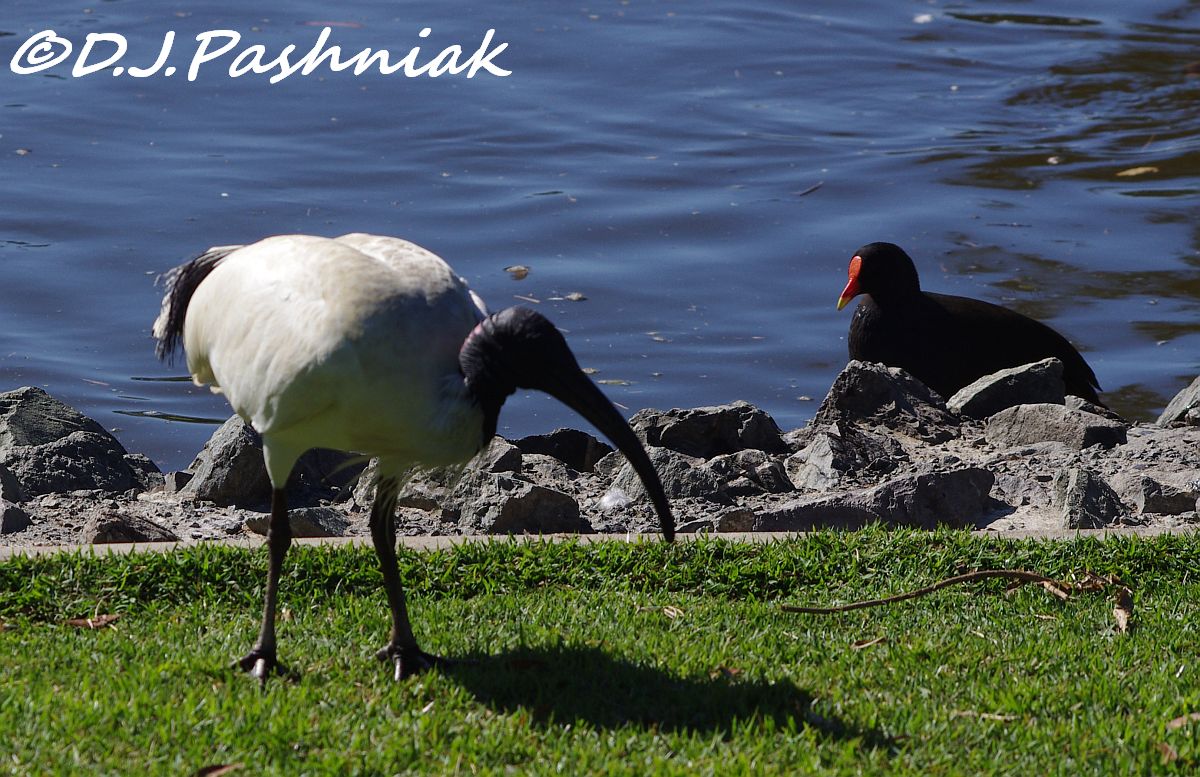
These two birds are very common - an Australian White Ibis and a Dusky Moorhen.

I only looked at the main pond but if you walk around and watch carefully there are lots of other birds around. Go over to my friend's blog (Out and about in Cooloola) and see what she photographed just one day after I went there!

For more scenery from around the world visit Our World Tuesday

and for more birds visit Wild Bird Wednesday