Tuesday, July 30, 2013

A Visitor's View

I enjoy living with so many beautiful places so close around, and I also enjoy showing these places off to friends who visit me. Last week - on one of the few days without rain - I took a couple of friends for a quick visit  to places around here that I especially enjoy.
We drove first to Inskip Point and walked from the parking place out onto the sand at the end of the point. Unfortunately there were no shorebirds waiting for us as there were too many people around and the tide was not right. However, the scenery is always beautiful - this photo is looking from the road over towards Fraser Island.

There are always bush birds to see and this little Red-backed Fairy Wren was fluttering around in the same tree where I saw a pair last time. I wonder if there is a nest close by.

We then drove on to Carlo where there is a ramp for boat launching and various other boats moored to the docks. There are also picnic tables and shelters - a perfect place to sit and eat and enjoy the sound of the birds high in the trees above. We saw a group of pelicans further along the shoreline and were walking towards them when they suddenly moved and swam past us. There were a couple of small boats just coming in to land and the birds obviously were hoping for a hand-out! When it didn't happen quickly enough a couple of them flew up and perched on one of the lamp stands. It always seems strange to me to see these big birds perched way up high like that.

There were other people sitting at another picnic table and I don't know if these crows were being fed or if they just hoped to be. I realized a while ago that I had never photographed crows up close. They are handsome birds but I can't help thinking of the old saying - "handsome is as handsome does"- and crows are noisy bullies and have the nasty habit of taking small birds out of nests and sitting and eating them while the parent birds scream and cry in frustration!
There is also a distant view from Carlo over the bay right back to Tin Can Bay.

We then drove back to Rainbow Beach and looked at the beach from the viewing platform close to the surf club building. This photo is looking north along the beach.

This photo is looking south towards the lighthouse on Double Island Point.

The Seary's Creek picnic area is on the way home. There is a board walk through the bush which leads down along the creek. It's beautiful and peaceful and I am always fascinated by the color of the water and the reflections of the trees and bushes in it.

For more scenery from around the world visit Our World Tuesday

and for more birds visit Wild Bird Wednesday.

Tuesday, July 23, 2013

Sunshine Coast

Last week I made a quick trip down to Esk to see family. On the way home I traveled along the range instead of using the motorway along the coast. I went through Maleny, Montville, Mapleton, and got on to the freeway again at Nambour. There are magnificent views all along this route.

The land drops away very quickly and you can see all the way to the coast - or at least you can if the weather is good! Unfortunately, there was fog and low cloud around and the views were restricted because of this. We stopped first at the look-out a short way along the road to the Mary Cairn Cross Reserve.

The view out to the coast includes the Glass House Mountains which were named by Captain James Cook as he sailed up the coast in 1770. These mountains rise straight out of the coastal plane and are the remnant cores of extinct volcanoes. In this photo they are just visible through the mist and cloud.

The only birds I saw were these Crows - and I couldn't get close photos because I had the 50mm lens on the camera for the scenic photos.

This view was taken at another look-out between Maleny and Montville. The view is looking northward.
 Next time I travel on this route I hope the weather is nice and clear and good for photos!

For more scenery from around the world visit Our World Tuesday

and for more birds visit Wild Bird Wednesday.

Tuesday, July 9, 2013

Ibis

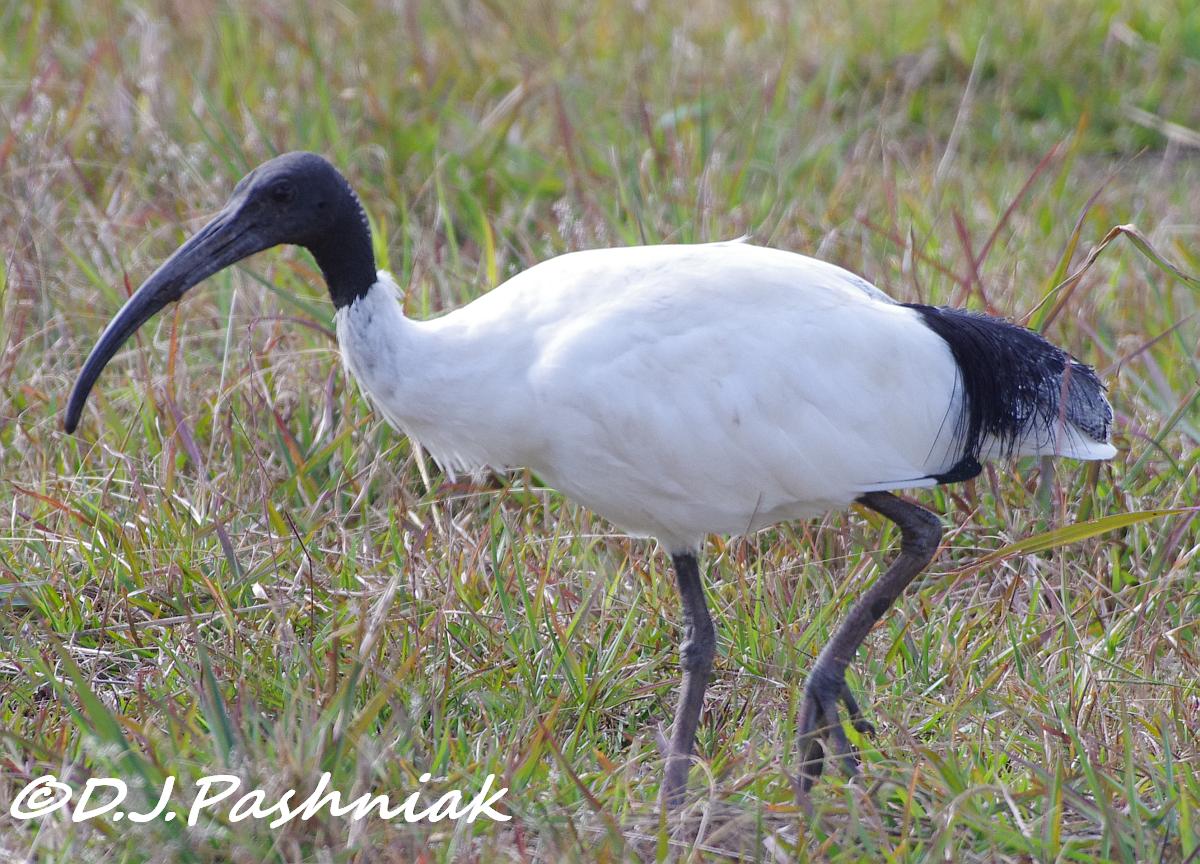
The other week I posted some photos of Australian White Ibis (Threskiornis molucca) and was quite surprised at the interest shown by overseas readers of the blog. I think we often forget that what is common and unremarkable in the local environment is not so in other places.

White Ibis have become common in cities and towns on the east coast of Australia. These birds have the unfortunate ability to adapt to feeding on whatever humans drop or put into rubbish bins or land fills. When city parks become home to hundreds of these large birds (65-75 cms or 25-30 inches) then local councils are pressured to do something to control them. Some cities have simply culled them. A few years back Brisbane council hired a man with a trained Wedge-tailed Eagle to fly over the parks where the Ibis were the most numerous. It worked! However, at the same time as the birds are a problem in urban areas, they are becoming scarce in inland wetland areas. So a debate has been raging as to whether they are a pest or an endangered species.
The Straw-necked Ibis (Threskiornis spinicollis) is about the same size as the White Ibis but it has not adapted to eating human left-overs! It is found around fresh water swamps and in grassland. It eats small aquatic creatures and also grasshoppers and crickets etc. Because of its liking for grasshoppers etc it has been called the "farmers' friend". Ibises also use their long bills to probe into the ground for food. Yesterday, I saw these Straw-necked Ibis busily moving across some vacant land and picking up whatever insects moved. I frequently see both kinds of Ibis around town.


For more birds from around the world visit Wild Bird Wednesday.

Tuesday, July 2, 2013

Early Morning

It's great to get well lit and detailed portraits of birds - but it's also great to get photos of birds in the landscape - or in this case - the 'sky-scape'.
My family room looks out to the north-east through sliding glass doors. I frequently sit there first thing in the morning and watch the sun come up and the birds begin to wake. The other morning this Spangled Drongo (Dicrurus bracteatus) sat high in the tree.

Spangled Drongos are glossy black birds with a long fish-shaped tail. They twitch this tail backwards and forwards.

They are noisy birds and this one soon called a mate to sit up there and make their raucous voices heard. Of course, the colors of the sunrise were changing all the time.

For more birds from around the world visit Wild Bird Wednesday.

Tuesday, June 25, 2013

Inskip in Mid-Winter

It had been a few weeks since I had been out to Inskip to look for shorebirds so I tried to make sure that the weather would be suitable for photos. The previous day had been perfect and the weather report was for "mostly fine and sunny". I checked outside my back door as soon as it began to get light and the sky looked clear. However, by the time I got out there a big bank of cloud was covering Fraser Island and rapidly moving south. It was dark - definitely not mostly fine and sunny! Weather like this gives interesting sky photos - but not great bird photos, unfortunately.

It was nearly 7am by the time I got out to the Point, and already there were fishermen and vehicles on the sand. The barge was also waiting to take vehicles over to Fraser Island. However there were still birds roosting on the sand. The first birds I saw were a group of Terns. The photo shows (from the left) a Gull-billed Tern going out of breeding plumage, a Crested Tern also in non-breeding plumage, and four young Caspian Terns.

As I was watching the Terns a line of Pelicans flew in from the north going towards the sand island out in the bay.  They joined the Pelicans already roosting out there. Western Queensland has been drying out and the Pelicans that have bred out there are moving to the coast. We have recently seen a big increase in their numbers around here.

A little later another group flew in from the same direction but this time a group of smaller shorebirds were also flying towards the island. They are just visible flying closer to the water.

There were groups of small shorebirds - mostly Red-capped Plovers and Red-necked Stints - roosting in the dry sand. I also saw numbers of Double-banded Plovers - with one "early" bird well into breeding plumage. They will not migrate back to New Zealand where they breed until it gets lots warmer over there!

Further along the point there was quite a large group of migratory shorebirds roosting close together. These birds are young birds that do not migrate until they are 2-3 years old.

There were at least 150 Grey-tailed Tattlers (paler grey on top and white below) with a few Bar-tailed Godwits (the larger birds in the flock) and a few Great Knots (smaller than the Godwits but also with heavily patterned feathers down their backs).

For more scenery from around the world visit Our World Tuesday

and for more bird photos visit Wild Bird Wednesday.

Tuesday, June 18, 2013

Lake Alford

I had an extra trip in to Gympie yesterday. (Gympie is my nearest bigger town and a bit over 50kms away.) I would much rather have been out looking for birds but decided to take my camera in with me and make a quick stop at Lake Alford before I came home. Lake Alford is a well maintained park on the highway just south of the business district in Gympie.  The water in the lake/pond is kept moving and aerated with fountains.

I didn't see any new birds but these are not ones that I see out where I live at the coast
Pacific Black Duck (Anas superciliosa)

Male Hardhead (Aythya australis) 

Dusky Moorhen (Gallinula tenebrosa)

While I was there a father with a very young daughter came and sat down at the edge of the pond with a loaf of bread. The birds knew what to expect and before he even had the packet open they started to make a rush for that area of the pond. Even the Black Swan joined the rush! I do occasionally see Black Swans on the Bay.

Australian White Ibis are very common everywhere!

This juvenile even came into my back yard the other day when it was raining.

For more scenes of our world visit Our World Tuesday

and for more birds visit Wild Bird Wednesday.

Monday, June 10, 2013

Double Island Point

I have lived here for 10 years and during that time I have only seen Double Island Point from around Rainbow Beach. It is the most southerly point visible along a long line of beach which curves away to the south east. So although the other parts of the National Park that I visited with Sarah and Graham were interesting and beautiful, the high point of the day for me was to finally see Double Island Point close up.

We reached it by traveling from the south along the beach. After so many miles of sandy beach this rocky headland is magnificent. This photo is looking south from the point.

This photo is looking to the east along the southern edge of the point. With sunshine and a blue sky the sea is a mixture of blue/green  colors.

I am told that this area south of the point is a favorite place for surfers. There were two people surfing there that day and both appeared to be on longer boards.

Of course, I was looking forward to going to the top of the Point and seeing the lighthouse up there. I had been warned that it was a steep climb - and it was! The track was well made - but the lighthouse is at an elevation of 96 Meters (314 feet). (And, unfortunately I am not as fit as I would like to be!) This is the view south from about half way up.

There are also views looking down the steep rocks to the sea below.

Finally, I made it! The lighthouse was built in 1884, flashes every 7.5 seconds and has a range of 26 nautical miles. It was automated and demanned in 1992 and now runs on solar power.

The view from up there is fantastic! This photo is looking northwards. Rainbow Beach is just beyond where the sand blow over the hills is visible.

This photo looks right up towards Fraser Island which shows just where the very low land of the peninsular rises. This is also where the channel is between the island and Inskip Point and if you enlarge the photo you can just see the bay waters as a silvery line behind the first line of land.

Thanks again to Sarah and Graham for a truly wonderful day!


Were there birds around the lighthouse and the Point? Of course! Did I get photos of them? No! I was too concerned about making it up and back under my own steam! So for this week I am showing some Sulphur-crested Cockatoos.
White Cockies fly over my house every morning. For the last few days some of them had been dropping down into my back yard. They had already eaten (or demolished!) the fruit on my Passionfruit vine so I wondered what they were getting at now. When I walked out to where I had a better view I saw them on the ground beside my little Kumquat tree. (This is a  citrus tree with very small fruit that has a sweet rind and flesh.) I grabbed the camera and walked down there to chase the birds off and to get what photos I could manage in the half-light of early dawn. There were eight birds in total and each had a Kumquat! Needless to say there were not too many left for me! Some Cockies were up on the fence and one was swinging from the top frond of the palm tree. Feet hold food just as well as beaks!


One extra bold bird stayed on the fence to make sure I really was chasing them all away.
( Just for interest - do others remember to change camera settings when you are rushed and just trying for any photo possible? I know my camera is capable of much better low light photos but that morning I just left it on automatic and was happy for anything I got.)

For more photos from around the world visit Our World Tuesday 

and for more birds visit Wild Bird Wednesday.