Tuesday, April 16, 2013

Birds on the Sand Flats

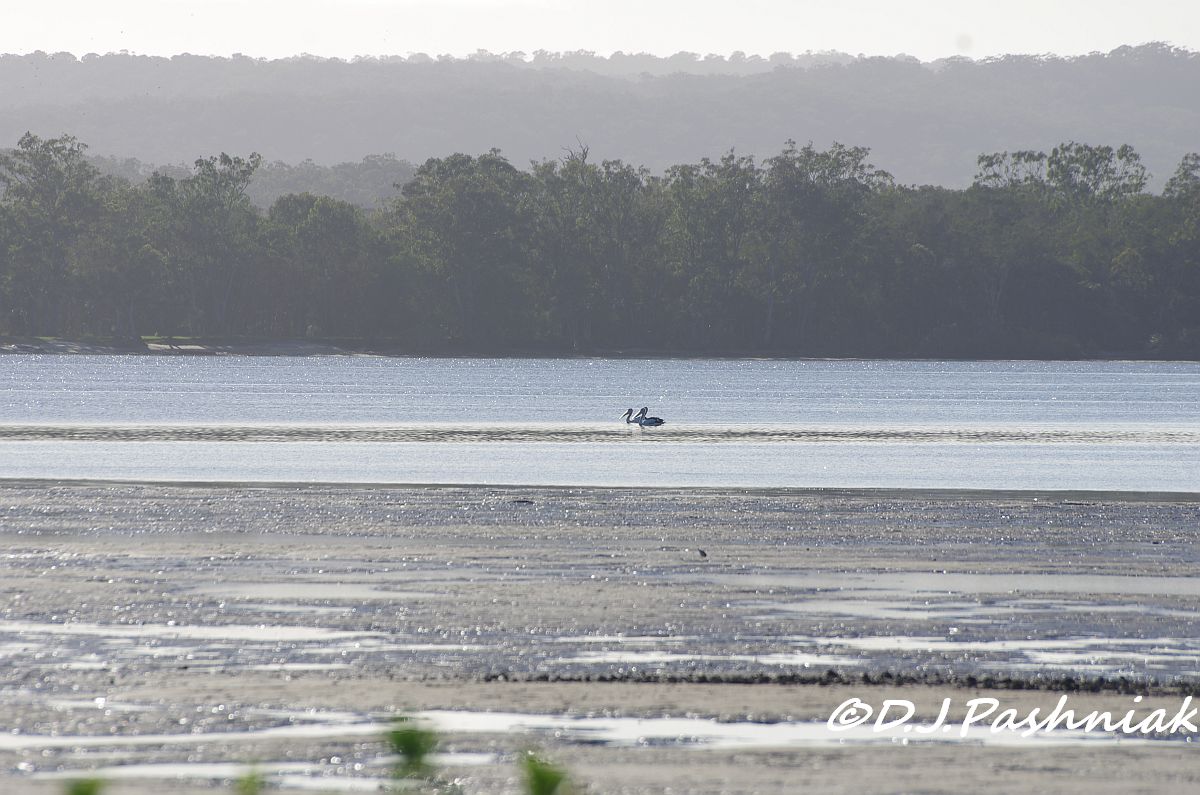
All these photos were taken earlier this week on a perfect morning down along the bay at Cooloola Cove. It was early in the morning and the tide was well out but slowly coming in.

At first the only birds that I saw were some pelicans way out where there was still some water.
The gradient is so low in the bay that it doesn't take too long for water to slowly seep in on the incoming tide. As it did there were more birds to see - but all a good distance away. There is no chance of getting close-up photos of birds out on the sand flats. Birds see you long before you see them! I heard Grey-tailed Tattlers and when I followed the sound I saw these two birds hunting for food in a puddle of water.

I saw and heard more Tattlers than any other bird that morning. Many of the other shorebirds have already left on their northern migration.

The next bird that I saw was a Double-banded Plover. These birds breed on the braided river channels in south New Zealand and come here for our winter. Of course the Queensland winter is a lot warmer than winter in south New Zealand.I saw quite a number of these birds a good distance away.

There were lots more birds further away which it was difficult to ID. I saw a few Bar-tailed Godwits but most Godwits have already left. I heard an Eastern Curlew but it was too far away to see properly. Most of the birds I saw were smaller shorebirds. Of course there were numbers of Red-capped Plovers (local shorebirds). When I looked at my photos at home I saw a couple of Lesser Sand Plovers with the red splash of color across their front which is their breeding plumage.

Being out on the sand flats when the tide is coming in does give some indication of how many shorebirds are still around but it is definitely not the right place to try for good close photos of any of the birds.

For more photos from around the world visit Our World Tuesday

and for more birds from around the world visit Wild Bird Wednesday.


Wednesday, April 10, 2013

A Piece of Paradise

This is my friends' backyard and it's a beautiful and peaceful place. (You really need to read my previous post to understand the implications of this title!) The only creatures here that could be thought to detract from this lovely environment would be the mosquitoes - and they are around everywhere after the rain!

We were sitting out under this sun shade the other morning and enjoying a "cuppa" together. I had not intended to stay long so had not brought my camera. What a mistake!

There were a number of Sulphur-crested Cockatoos sitting up in this big Scribbly Gum and popping in and out of one of the holes. We all assumed they are about to use it as a nesting hole.

I asked Sarah if I could come back the next morning and just wander around for a while and get some photos of the birds. Cockies - like all parrots - are clever! They were at the hole when I first arrived but as soon as I got the camera out they flew up into the tree and sat and watched me. It felt like they were laughing at me! Then they even had the audacity to invite their "birdy" friends (a couple of Rainbow Lorikeets) to come and share the joke!


I was a strange person wandering around in their place and they did not trust me! It was only after Sarah and Graham came out and sat down under the sunshade with me that the birds came down and briefly went to the nesting hole. I managed a couple of photos before they flew high into the tree again. Hopefully when they do start nesting and have young demanding food I can go and get some better photos.

 For more bird photos from around the world visit Wild Bird Wednesday.

Monday, April 8, 2013

A Serpent in Paradise

I always wake up early and as soon as I stir inside the house my animals - a dog and a cat - let me know they expect me to come out and say "good morning" and give them some food. So the other morning it was just after 5am when I switched on the outside light and went along to the pen where the cat is usually penned at night. She had refused to come in the previous night but was frisking along at my heels this morning. When we were almost at the pen the dog jumped sharply back and I took a second look at what was ahead. Part way up the side of the pen and along a cross piece was a snake!

I don't like snakes - in fact I am frightened of them! I grew up in New Zealand where there are no "nasties" like snakes and I have never got used to them up close. At that hour of the morning what was I to do? I waited until nearly 6:30 and the snake hadn't moved. I phoned friends that I know are early risers and talked to my friend's husband. He asked what color and shape it was and told me I didn't have to worry because it was only a python of some kind - not poisonous and not dangerous! I had already worked that one out! (Isn't google wonderful at ID-ing strange creatures!) When I told him I was still frightened he told me he would come around in a while - and he did!  This is Graham, Sarah's husband. and as you can see he was not at all worried by the snake - and as you can see by the grin on his face he thought I was quite funny! Anyway he put the snake in a bag and took it away and released it well away from houses.

Sarah suggested the title for this post. She is an artist and I appreciate how her view of the world makes me take a second look at things and see them from a different perspective. We often go kayaking or hiking. While I watch and photograph the birds moving around and am delighted with their color and pattern she goes looking at vegetation and comes back with detailed photos of small and delicate plants - with a bleached bone sheltered underneath the foliage! I think she would like me to find the things that are less than perfect as well as the very beautiful things around where we live.

For more photos from around the world visit Our World Tuesday

Tuesday, April 2, 2013

Floods and Fairy-Wrens

These first two photos were taken during one of the big floods we had at the end of January and into February. This water is running into Carland Creek and a few hours before this had been over the road. There had been a fire go through the area a while ago and the burnt bushes are Hakea. In the second photo I focused my camera on the bushes and seed pods which made an interesting pattern in front of the flooded gully.

I see Fairy-Wrens quite frequently but like most wrens they seldom sit still to have their photos taken! I saw these Red-backed Fairy-wrens (Malurus melanocephalus) beside the road out at Inskip Point very early in the morning. The male is all black down the front. It looked as if he had been ruffling the feathers on top of her head.

 They didn't stay sitting still together for long. The female flew off deeper among the branches where I couldn't see clearly enough to photograph her again but the male flew around from branch to branch. First he had a good preen then he gave me good views of his colorful side and back feathers. I am always intrigued by how the red on his back shows different shades in different light.


For more photos from around the world visit Our World Tuesday 

and for more bird photos visit Wild Bird Wednesday.

Tuesday, March 26, 2013

A grey day

Perfect weather has been so scarce recently that when I saw the weather forecast for light winds and an early high tide I decided to ignore the prediction for some cloudy periods. I wanted to get out to the Airport Roost and count the shorebirds there before they all left for the northern hemisphere. When I got down to the shoreline to put the kayak in the water the sky was very dark. The water, however, was very still and beautiful.

After kayaking out to the roost we counted 45 in a mixed flock of Grey-tailed Tattlers and Terek Sandpipers, 20 Whimbrels, and 3 Greenshanks which were showing a lot of breeding plumage. We also saw some local shorebirds - 2 Pied Oystercatchers, a Little Egret, and a Pied Cormorant. It was too dark to get good photos of any of these birds - but then the sun broke through for a short time and it looked a totally different place.

When I got back to the shoreline where I had parked my car this little Willie Wagtail (Rhipidura leucophrys) was catching insects among the leaves washed up by the tide.  I let the kayak drift in until the front came to rest on the sand and then just sat still. These birds are quite fearless! It watched me as carefully as I was watching it - and hopped closer until it was only a few inches from the front of the kayak. I love those eyebrows! The bird makes the eyebrows larger for a threat display - and its harsh chattering calls showed it did not like me so close to where it was looking for food.

For more photos from around the world visit Out World Tuesday

and for more bird photos visit Wild Bird Wednesday.

Tuesday, March 19, 2013

Trees in my yard

I want to have a moan and a whinge this morning because the big wet we had in January and February has caused more destruction in my yard than I had realized! As soon as the yard dried out I had a friend come in and chop up and cart away trees and bushes that had been blown down. However, this week I discovered that the big Grevillea tree has to go also. The side that I see is fine but the other side which reaches over the fence is broken and falling down. I planted this tree soon after I came here because I noticed that Grevilleas attracted more honey eating birds than anything else around here. Unfortunately, Grevilleas around here are not long lasting trees and shrubs - and I have neglected to plant young ones to carry on! If I get another tree of the same kind - immediately! - I wonder how long it will take to grow and flower and attract the birds again. So-o-o-o - this post is in praise of my late Grevillea tree and the birds it attracted! Here it is under a grey sky -

 and at sunrise under a red sky.

Rainbow Lorikeets especially liked this tree - and I especially liked photographing them.

Blue-faced Honeyeaters tried to keep this tree for their own special use. They are most aggressive birds!

Noisy Friarbirds were often among the branches.

Little Friarbirds were also frequently around but much less easy to photograph.

Then there were the birds that came and rested briefly in the tree. This Spangled Drongo was one such bird.

And this Galah was another.

Even the Sulphur-crested Cockatoos came down for a while.

My favorites were always the Rainbow Lorikeets!

For more photos from around the world visit Our World Tuesday

and for more bird photographs visit Wild Bird Wednesday tomorrow.


Tuesday, March 12, 2013

Ready to Migrate

Well, the very heavy rain has stopped! My yard has dried enough for me to get the lawn mower over it but there is still lots of water lying in low places along the roads. I can just imagine how wet some of the walking trails are! There are still short sharp rain showers every day which is enough to keep the water levels up. Of course heat plus water equals mosquitoes - and lots of them! It is still not good weather for kayaking as there have been strong winds every day and I am just not into extreme effort in kayaking! So to see shorebirds up close it was off out to Inskip again in the early morning.
Rainbow Beach is about half way to Inskip from where I live. This was the view from Rainbow Beach.  Looking south towards Double Island Point it was very hazy so I decided to bring the trees into sharp focus and leave the rest showing the haze.

Looking north towards Fraser Island the sea was very rough and the force of the recent weather showed in the high sand cliffs at the edge of the water and the piles of broken trees and branches that littered what beach was left.

I had checked the weather reports before I left home but out at Inskip Point the wind was far higher than I expected. I had trouble standing still and even though I was using a monopod for my camera a lot of photos were blurred from the wind gusts. There was lots of sea foam washing over the point and dropped there with every wave that washed and then receded. There were a variety of shorebirds but the Bar-tailed Godwits were especially interesting. They looked ready for migration and will be leaving over the next few days and weeks. They fly directly to the Yellow Sea area between China and Korea. Then they rest and eat for a month or 6 weeks and then do another long flight to Alaska where they breed. 
Both of the Godwits in the next photo are showing how fat they get before they start migrating. The male has the dark red plumage but the female is still showing very little color. (Males are slightly smaller than the females and their bill is slightly shorter.)

This female Godwit is showing more color - and very intent on preening each feather into place. Look at the contortions necessary to preen everywhere with that long bill!


On the north side of the Point there is a small lip of sand which drops down to the water. There were numbers of Godwits feeding in the softer sand as each wave came in and then retreated.The drifts of foam were all along the water's edge.

Most of the time they timed the waves perfectly and scurried out of reach of the bigger ones. Sometimes however it was necessary to use their wings to fly/hop out of reach.

Then it was back down to the water's edge to feed between waves.

For more photos from around the world visit Our World Tuesday

and for more bird photos visit Wild Bird Wednesday.