Showing posts with label Curlew Sandpipers. Show all posts

Tuesday, February 7, 2012

Massed Shorebirds

This post is for World Bird Wednesday.

I went out to Inskip Point soon after sunrise this morning. At that hour of the morning I was lucky to find shorebirds and terns all over the point and no people to disturb them. Even the car ferry for Fraser Island arrived after I did.
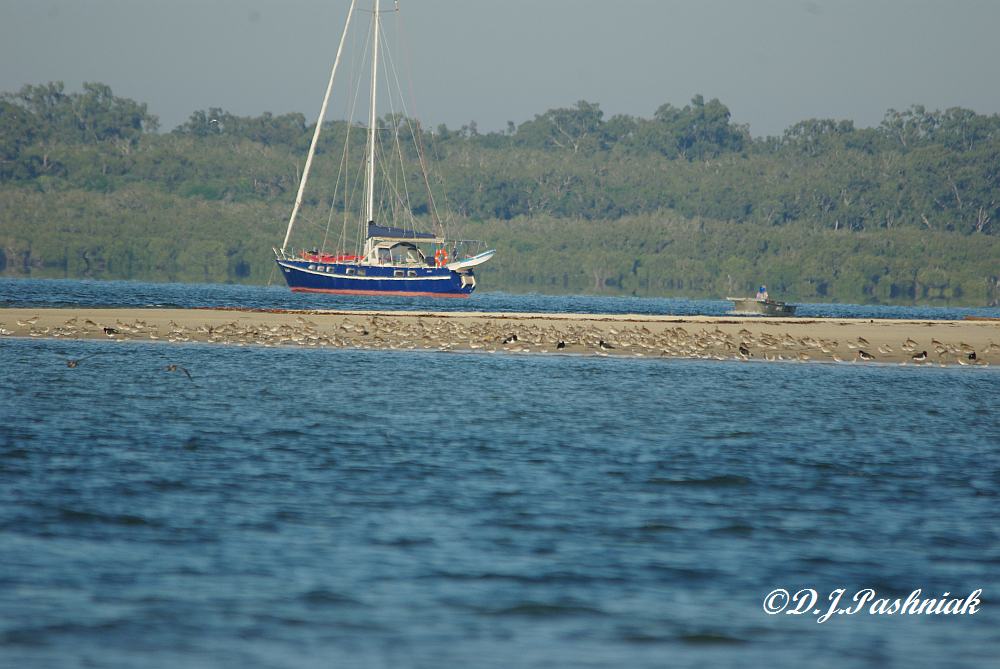
I estimated there were 1000+ shorebirds strung out along the water line on the southern side of the point and flocks of terns and small shorebirds roosting in the dry sand of the point in among the flotsam that is always washed up and left by the tide.
At first it seemed that there were only Bar-tailed Godwits in the flock on the southern side. Some of them were getting a faint wash of red breeding color down their frontsGradually it was possible to see others. There were Common Greenshanks roosting a little away from the Godwits and standing in slightly deeper water.
Then I saw slightly smaller birds in among the Godwits and I focused in on that part of the flock.
It was easy to see Great Knots. Some of them were getting their more heavily marked breeding colors. (Great Knots and one Bar-tailed Godwit in the rear.)
There were also numbers of Curlew Sandpipers.
They are never as easy to see as they like to roost even more closely among the Godwits. Sometimes all you can see is a smaller set of legs and part of a small bird in behind the Godwit.

Sunday, April 17, 2011

Migrating Shorebirds

I went out to Inskip point the other morning. I thought that I was early enough to be the first out there but there was already a vehicle and boat trailer sitting out on the end of the point.
There were lots of birds out on the sand island and enough roosting on the point to make it interesting.
Most of the larger birds such as Bar-tailed Godwits and Eastern Curlews have left and the ones still here are possibly juveniles that will spend the winter here. I had seen very few Grey-tailed Tattlers (Tringa brevipes) when I was last out here a couple of weeks ago but now there were good numbers of them and most were in breeding plumage.
Although some were roosting by themselves at the edge of the water others were in among the Bar-tailed Godwits. This photo shows the considerable size difference between the two species.
This photo shows a Grey-tailed Tattler on the left, a Bar-tailed Godwit in behind and a Great Knot in the front. The Great Knot is in breeding plumage.
I saw a couple of Curlew Sandpipers also in breeding plumage in among the Bar-tailed Godwits. They are not easy to see when they walk in among the much larger birds.
For more bird photos visit the Bird Photography Weekly.

Tuesday, March 22, 2011

More Colors

This post is for World Bird Wednesday.

There were several thousand Bar-tailed Godwits (Limosa lapponica baueri) roosting at Inskip Point on the very early morning high tide last week. Many of them were showing beautiful red breeding colors. It is the males that get this lovely bright red all down their fronts. The females have just a faint wash of color and are more heavily barred. The red color will become even darker but I seldom see the really bright colors here.
The back of the bird also gets more intense color.
When I looked at my photos from the first morning I was out there I saw one dark red splash of color in one photo which I almost dismissed as another Godwit. However, when I looked the second time I realized this was a much smaller bird and by comparing it with others roosting near-by I realized I had photographed a Curlew Sandpiper (Calidris ferruginea) with red breeding colors. I had never seen one of these birds with such dark color. In the spring when they first arrive here they have red splashes of color down the front - but this was a bird with all-over red! I had to go back the next day and try to see it again. Curlew Sandpipers have a bad habit - from the point of view of the birdwatcher! - of roosting right in among the Godwits and often all you see are a smaller set of legs in behind! I took friends out with me the next morning and we stood and watched and photographed the birds for a long time before we saw any Curlew Sandpipers at all. However, it was worth the wait. The whole flock started moving as the tide went out and we saw a number of birds with quite a lot of red down the front.
Curlew Sandpipers in front and Godwits behind.
Curlew Sandpiper in front then Great Knots and Godwits behind.Bar-tailed Godwits breed in Alaska.
Curlew Sandpipers breed in the high arctic tundra from Siberia west.

Sunday, December 12, 2010

Inskip Point

Inskip Point can be a very good place to see shorebirds. When the tide is very high the sand island out in the Strait where they usually roost is not big enough for them all to find a place to roost so they often use the Point itself. However, there is a lot of human disturbance there so the only way you can be sure of finding them is to choose a high tide early in the morning before there are too many people around.
It was another gray day with the promise from the weather bureau of more rain. I took a rain coat and bags to put the camera into out of the weather - if needed! The light was bad - so all of the photos have been adjusted to make them lighter. As soon as I walked out onto the sand I could see quite a large flock of Terns. I walked closer and saw Crested Terns, a couple of Caspian Terns, Common Terns and Little Terns. ( All photos enlarge when clicked on.)
The Terns were standing on the lip of sand just before it dropped down to the water. Then I noticed that in behind them and closer to the water were a number of shorebirds. Every time the waves broke they had to move a little. These are Crested Terns in full breeding plumage in the foreground of this photo with a shadowy line of shorebirds behind them.
All the birds moved again and I was able to get photos of the shorebirds without the Terns standing in front. There were numbers of Bar-tailed Godwits and also Great Knots and Curlew Sandpipers. The Bar-tailed Godwits are the largest birds with slightly up-turned beaks. The Great Knots are smaller with straight beaks and the Curlew Sandpipers are a little smaller again with slightly down-turned beaks.
The birds all started to move again and when I looked around there was a man walking along the edge of the water. The birds all flew up and some of them flew to the other side of the Point and roosted there at the edge of the water. The man walking continued around the Point and then started back along the other side where the birds were now roosting. This time when they flew they left! Some went out to the sand island and some went over the channel towards Fraser Island. It's not easy for shorebirds when there are tourists and fishermen all around!
For more bird photos visit the Bird Photography Weekly.