Sunday, July 10, 2011

Bellbirds - Finally!

I thought of starting this post with one of those sayings about the value of 'patience' and 'persistence' but then decided that it would be enough to tell you the length of time it has taken to achieve this goal. It has taken me fifty years to see Bellbirds instead of just hearing them! It is easy enough to hear these birds. Even driving along in the car - with the windows down, of course! - they are easy to hear. However, I have found seeing them a different matter. They have always been high in the trees and any movement of birds I could see was just a LBJ (little brown job) moving very fast!
When my friends Neil and Kell suggested a day out looking for bush birds I told them that actually seeing a Bellbird would be top of my list! These friends have watched birds in this district for many years so they suggested that Brooloo in the Mary Valley was the easiest place they knew for Bellbirds.
The proper name for a Bellbird is a Bell Miner (Manorina melanophrys). They are a smallish bird (19 cm) and colored olive green which of course just appears brown up against the sky. Their call is a high-pitched bell sound - hear it here. They have a dark yellow beak and legs and a yellow patch in front of the eye.
Bellbirds feed in among the leaves of trees and there is a dense stand of forest at Brooloo. However, there are also a number of dead trees as well and the birds seemed to choose these trees in which to rest.
The birds were still very high in the trees but just within reach of my long lens. One of the birds sat up there and fluffed its feathers out and then preened before flying off as fast as it had come.
This was certainly the highlight of the day for me. We then went off to another spot in the bush were there were more Bellbirds and a variety of other birds. Neil and Kell thought that the birds in this other spot were even better! More about that in the next post!

For more bird photos go to the Bird Photography Weekly.

Friday, July 8, 2011

The Valley Rattler

I had a great day out birding in the Mary Valley on Wednesday. I saw some birds that I had wanted to see for a long time - but I shall leave them for posts next week. On the way home we stopped at Imbil - which is the end of the line for the historic Mary Valley Heritage Railway. This railway has been operating as a tourist train since 1986 which was just a few years after Queensland Railway closed this section of rail line. The train is known as the Valley Rattler and is a popular tourist attraction. As we drove through Imbil the Rattler was about to start on its trip back to Gympie and I couldn't resist getting out and taking a few photos. It reminded me of the huge black thundering and smoking monsters that I used to see on all the rail-lines many years ago.
This is the first part of the line returning to Gympie.

Tuesday, July 5, 2011

Bush Stone-curlews

This post is for World Bird Wednesday

This morning I was invited to visit a beautiful bird-friendly garden. Brian and Sue have been living here for about twenty years and they have a garden filled with mature trees and shrubs as well as areas of low-growing foliage and flowers. Many of the trees and shrubs are flowering and fruiting varieties that the birds love. There are also areas of low growing foliage where the ground is mulched and plenty of dried leaves are left for ground dwelling birds to hide in among. Add to all this beds of veges and herbs and large beds of strawberries.
I could see birds flying between the trees but I had come to see a special pair of Bush Stone-curlews (Burhinus grallarius). These birds have been in this garden for a number of years and have nested and raised young ones here. There are no cats or dogs to bother them and they are used to people moving quietly through the garden. They have a couple of favorite spots where they can sit down among the plants and get lots of winter sunshine. (Click on photos to enlarge them.)
(Added later! I should have given an indication of the size of these birds. Length 550mm including 180mm tail and 45mm bill. These birds are NOT small!)
Birding books say that Bush Stone-curlews are shy and more often heard than seen. However, they can also become used to people around them in places where they feel safe. The garden this morning was very peaceful and it was great to have the opportunity to see these birds so close. Thanks Sue and Brian!

Sunday, July 3, 2011

Scarlet Honeyeater

This post is for Bird Photography Weekly.

It was a beautiful day for a walk along the foreshore at Mullens but a brisk wind meant that the small birds weren't sitting around out in the open. I could hear them back in among the trees but it is thick bush and not easy to see any small birds.
I was interested to see that a pair of Masked Lapwing have apparently claimed the little rocky island as their own.
This used to be a territory occupied by a pair of Pied Oystercatchers but the Masked Lapwings would be aggressive enough to chase almost anything else away. I saw only one Pied Oystercatcher and it was standing well away from the shore on rocks that were only just out of the water.
Around the corner into the area of saltmarsh I was out of the wind but the birds were still well back in the bush. I saw a flash of scarlet and followed slowly until I could see up into the tree where the bird had gone. It was a Scarlet Honeyeater (Myzomela sanguinolenta) - a beautiful bird but always very active. It was up high in a casuarina tree and almost out of reach of even my big lens. It was feeding on mistletoe flowers. Now if I could only take the best bits out of all these photos I would really have a great photo of the bird!

Wednesday, June 29, 2011

Beach Stone-curlews

This post is for World Bird Wednesday.

Yesterday afternoon I went out to Inskip Point with a couple of friends to do a count of the shorebirds and seabirds. There are always quite large numbers of Terns but if you want a full count of terns you must be there as they fly in at dusk. Even then many of them can still be heard coming in after dark when it is impossible to count numbers any more. We did not count as many as we expected to as there were storms all around and we left early.
I saw the most exciting birds for the evening right at the edge of the road as it goes out on to the sand. There were three Beach Stone-curlews (Esacus neglectus). This bird is listed as vulnerable in Queensland and in many places it is only just surviving. There have been two of these birds at Inskip for quite a few years but it was quite unexpected to see three of them. I have taken better photos of these birds when it was bright and sunny but I was delighted to get any sort of photo last night in poor light - and all three birds in the one photo!

Monday, June 27, 2011

Hole in the Beach!

The local TV news media last night had a story about a "sink hole" that had claimed part of the Inskip peninsular area. This I had to see!
Well it is spectacular but not as extensive as some of the stories were suggesting.
I parked in the parking area at the end and took the track directly opposite towards the channel and Fraser Island. This is where the wash-out has occurred. Previously there was quite a stretch of sand here. Now all the sand has gone and some of the shrubs and small trees have fallen in. This is what it looks like. (There was very little blue sky around.) All images enlarge when clicked on.
I then walked out to the end of the peninsular. There were four barges working. It is the beginning of school holidays.
This is what it looks like as I walked east back towards the area that has washed out.

Sunday, June 26, 2011

Try Again...

Some Other Time.
I frequently see Fantails around here but have yet to get a good photo of one. However, when Gouldiae showed great photos and said that they "frequently almost pose for a picture" I decided it was time to try again! Well, it didn't work any better this time! The one I was watching came down close but flew off into the tops of the trees again immediately. The best I could manage was a distant photo with the tail spread - way up in the top of the tree.
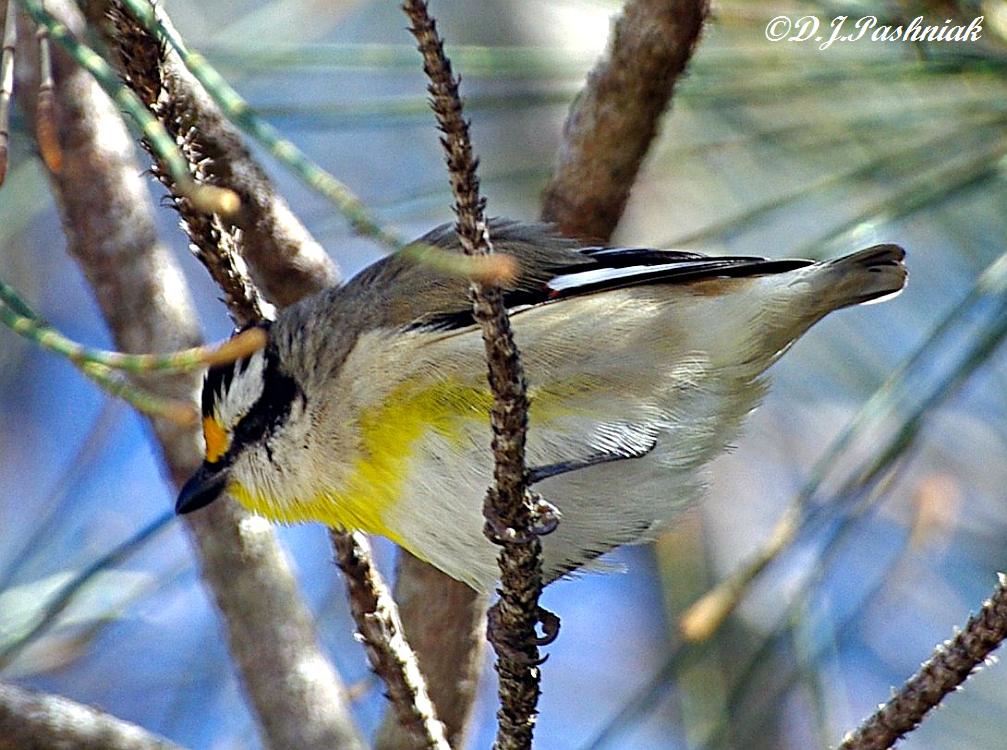
While I was waiting with as much patience as I could manage, another little bird came down close and really did sit and wait for its photo to be taken! It was a Striated Pardalote (Pardalotus striatus).
Some of my friends call this the "chip-chip" bird because of its distinctive two note call. It's a very cute little bird and I was glad to get some more photos - BUT - I still want at least one good photo of a Fantail!
For more bird photos visit the Bird Photography Weekly.