Showing posts with label Pacific Golden Plovers. Show all posts

Sunday, February 27, 2011

Pacific Golden Plovers

Yesterday morning was sunny and still so a great a morning for a walk along the bay. The tide had not been a very high one and it was already going out so there was not much water left at the Mullen's roost site. The birds were strung out along the far side - too far away for any good photos of individual birds.
Then I saw movement in front of me and realized there were Pacific Golden Plovers (Pluvialis fulva) walking in among the mangroves. There were three birds and each was at a different stage in changing into breeding plumage. The birds were directly in front of me and not in a good position for the light. Eventually one bird walked around and out into the water where the light picked up the colors of the plumage much better. However, the other two stayed in the shadows. I hope I can get better photos of the plumage change before the birds fly back to the northern hemisphere.
For more bird photos visit the Bird Photography Weekly.

Sunday, November 14, 2010

Counting Shorebirds

All the shorebird roosts that we monitor and count present challenges but one of the most challenging is the one we call the Airport Roost. It is a sandbank with mangroves growing on both sides of it. I have kayaked in to the side closest to the land but I have never managed to get out there without disturbing some of the birds into flying off. On the other side you must sit in the kayak and count from there. You can come in close enough to see the birds fairly clearly.

However, Terek Sandpipers and Grey-tailed Tattlers use this roost. They roost on the sand, on exposed mangrove roots and in the open branches depending on the tide height. Terek Sandpipers and Grey-tailed Tattlers are easy to distinguish if they have their heads up - the Terek Sandpiper has a bill that turns up slightly and the Grey-tailed Tattler has a straight bill. There is a also a difference in the color around the eye. When they are roosting with their heads tucked under their wings it is much more difficult. The Terek Sandpiper has darker orange colored legs, but this is hard to see at a distance with only binoculars. In this photo two Grey-tailed Tattlers have their heads up. There is a Terek Sandpiper on the right of the photo - and the others I am not sure of!
Now, spot the different bird in this photo!
There is a Pacific Golden Plover on the left of the photo. This is the only time I have seen a Pacific Golden Plover roosting in a tree. There were other Pacific Golden Plovers there as well but they were all on the sand.
For more bird photos visit the Bird Photography Weekly.

Tuesday, March 30, 2010

Shorebirds

The rain finally stopped! Or at least it turned into showers and it's been possible to get out on the bay. Unfortunately the clouds kept rolling over and everything then turned very dark. I still haven't got the photos of Godwits in breeding plumage that I want. Guess I'll have to wait until next season now. This photo was taken at the Mullens roost two days ago. The clouds had come up and also the wind. This always makes it challenging to try for photos from the kayak.Yesterday I kayaked over to the South Crab Creek roost site. There were still quite a number of Common Greenshanks there although they were showing very little breeding plumage. It will be interesting to see if any spend the winter here.This is a good place to find Pacific Golden Plovers. I found quite a few but they kept moving off when I approached. However, there were also numbers of Red-capped Plovers and Red-necked Stints in the same area and they decided to come over and investigate. They eventually scattered around just in front of me and this made the Pacific Golden Plovers settle down and I was able to get quite close. There was almost no wind and the reflections were great. Some of the Stints were showing some breeding plumage.The group of Pacific Golden Plovers were in different stages of breeding plumage. There was one in almost full breeding colors - very spectacular!On another part of the roost site there was another group of these same birds roosting in among the saltmarsh plants with some more Godwits.As I was paddling around the site it started to rain again. There was full sunshine but still rain coming down. It didn't last long. The BOM (Bureau of Meteorology) is predicting an increase in showers by the week-end. Nothing is perfect!
Tuesday, November 3, 2009

Shorebirds at Mullens

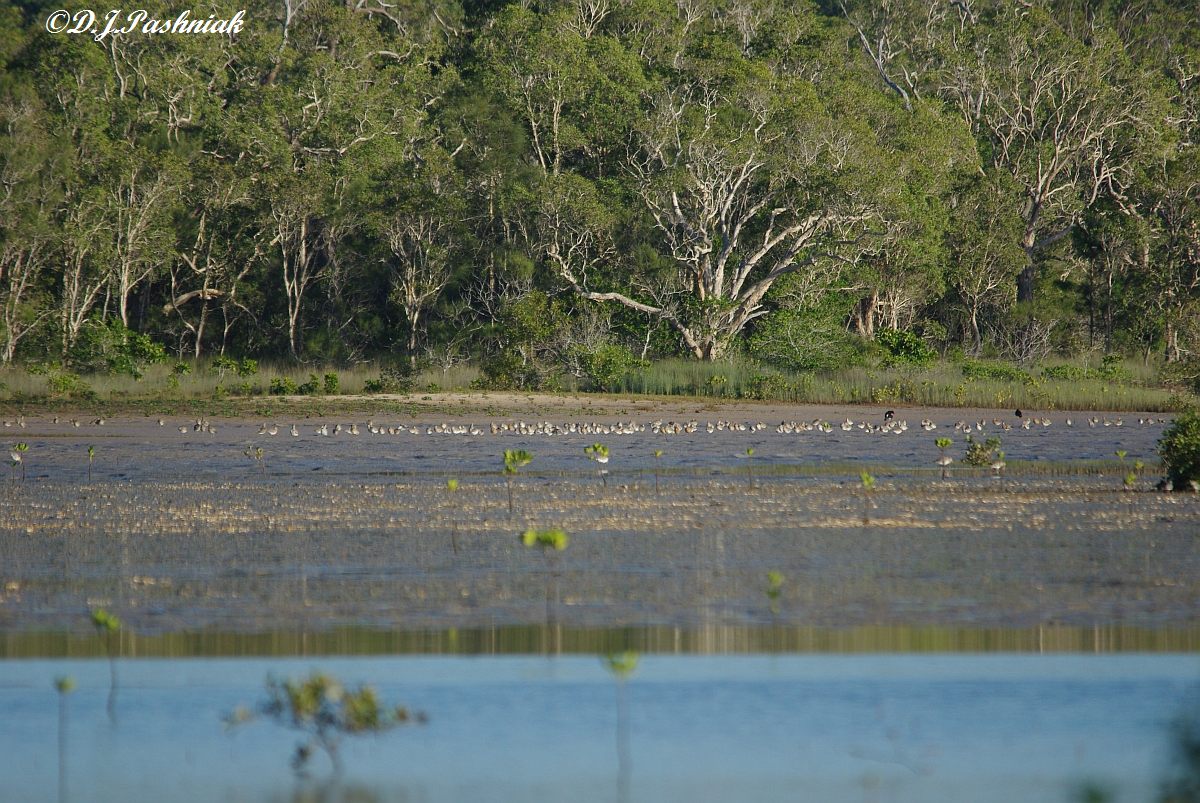
It was an absolutely perfect morning with quite a high tide so I decided to kayak around to the Mullens shorebirds roost. The birds were standing at the edge of the water in several places around the bay but none of them settled for long. I could not get close to any of them although I could not see what was making them fly off. When I first got there they were spread out at the northern end of the site which is not the place they usually prefer. Then they flew off to the southern end and then came back again later. None of these photos show any detail on the birds but rather show the kind of habitat they prefer in this area. (Click on the photos to enlarge them.)
Part of the flock at the northern end of the bay.
Mainly Gull-billed Terns and Eastern Curlews in silhouette against the light.
Part of the flock of Gull-billed Terns - quite a large number since breeding inland earlier this year.
Pacific Golden Plover - very difficult to see among the saltmarsh plants. These and the other smaller waders just disappear among the plants when disturbed.
Flying Past.
Spread out on the south-west of the bay.