A number of times while observing and photographing the shorebirds at Inskip I have seen flocks of birds, which have been disturbed by boats, or people, heading north-east across the channel to Fraser Island. I had been told that birds roosted at Hook Point and I wondered if this was where the shorebirds went when disturbed at Inskip Point.
I wouldn't have managed any part of this trip without the help and advice of DERM (Department of Environment and Resource Management) and QPWS (Queensland Parks and Wildlife Service) personnel. Moyra is involved in the management strategy for shorebirds in the Sandy Strait and she arranged for Ivan - who has an enormous amount of knowledge about the island and its wildlife - to meet us over there. Thanks to both!
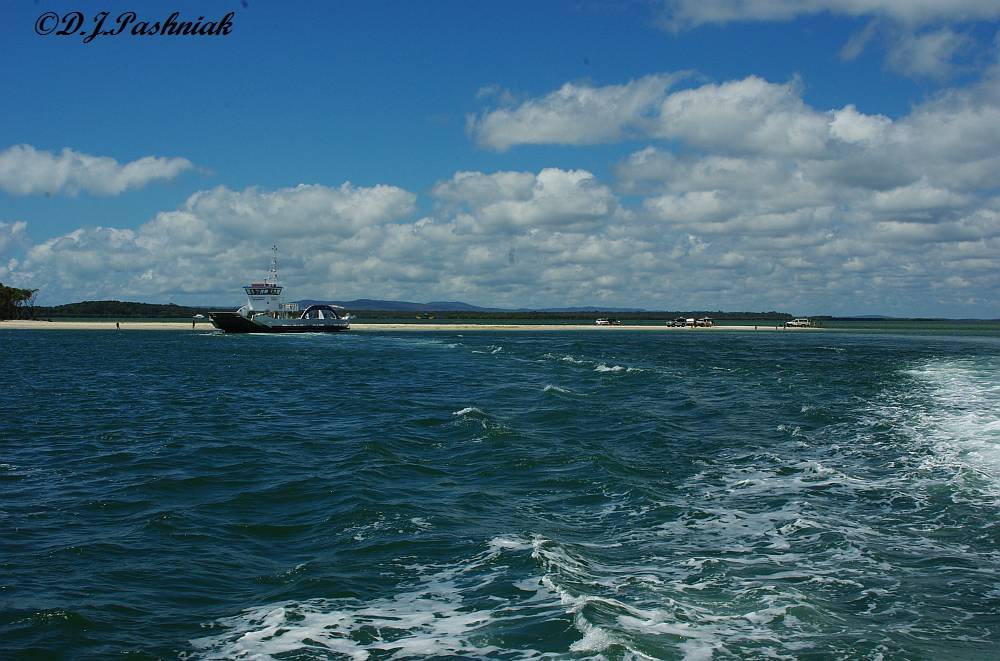
We took the barge from Inskip Point to the island. This photo looks back to Inskip Point where I usually stand and watch the barges!
Although we still had about 2 hours to go until high tide it was impossible to drive north on the beach. There just wasn't enough beach left out of the water! (btw I was very glad that I didn't have to do the driving as I have no experience with 4 wheel drives - and I am now not at all sure that I want it! Most of it was fun but some of it was a bit "dicey"! Moyra did a great job at all this!) The inland route is well graveled but extremely corrugated. These two photos were taken through the front window of the vehicle.


Ivan advised us how to access part of the beach north of Hook Point where there was a good wide stretch of beach well above the high tide mark for the day.

He also suggested that we drive north to where he had frequently seen birds roosting along the edge of the beach. The first birds that we came to were a small (100-200) flock of terns and a smaller flock of shorebirds. We parked well away so we didn't disturb them and then I went closer with binoculars and camera to get a better look. The shorebirds were Grey Plovers - just over 50 of them. I have never seen flocks of these birds on any roosts in the Strait. These ones were standing just out of reach of the breaking waves and just over a lip of sand which made them hard to see and photograph. Some of the birds still had dark patches of breeding plumage visible on their white fronts.


We drove north again but apart from flocks of thousands of terns we saw no more shorebirds. Then we headed south right down to Hook Point and again all we saw were terns - and one or two Whimbrels.
Part of a flock of terns- looking across the channel to the Inskip Point camp ground.

Looking south to the colored sand cliffs south of Rainbow Beach and Double Island Point in the distance.

So I am left with more questions than answers. Where do the shorebirds go when I have seen them flying off from Inskip Point? Do they only roost in the Hook Point area when there is absolutely nowhere else for them to go? It is very open and not the kind of place where shorebirds prefer to roost.
Of course Fraser Island is also known for being home to numbers of dingoes. I was so intent on looking for birds that I didn't even try to see a dingo. We had stopped both vehicles and were having a final consultation when a dingo walked out of the bush right beside us! Then it strolled across the road and sat down in the bush just across from us and watched us. Where's my camera? Grab it! Quick take a photo even though it's not the right lens. Do I have enough time to put the long lens on the camera again? The dingo stayed put and I got my photo!


For more bird photos visit the Bird Photography Weekly.


